Category Archives: writings by Whitman

Walt Whitman, “Jaunt up the Hudson”


“Jaunt up the Hudson”

June 20th.—ON the “Mary Powell,” enjoy’d everything beyond precedent. The delicious tender summer day, just warm enough—the constantly changing but ever beautiful panorama on both sides of the river—(went up near a hundred miles)—the high straight walls of the stony Palisades—beautiful Yonkers, and beautiful Irvington—the never-ending hills, mostly in rounded lines, swathed with verdure,—the distant turns, like great shoulders in blue veils—the frequent gray and brown of the tall-rising rocks—the river itself, now narrowing, now expanding—the white sails of the many sloops, yachts, &c., some near, some in the distance—the rapid succession of handsome villages and cities, (our boat is a swift traveler, and makes few stops)—the Race—picturesque West Point, and indeed all along—the costly and often turreted mansions forever showing in some cheery light color, through the woods—make up the scene.

— Walt Whitman, Specimen Days


*****************************************************

This is vintage, typical Whitman. A man who loved every minute of his life — savored it. Reminds one of this as it applies to our own lives. Knew how to express this beautifully. Felt and appreciated things keenly as few do.

jaunt (noun) — a short excursion or journey for pleasure


— Roger W. Smith

   August 2017

Walt Whitman on Manhattan (plus my own impressions and thoughts)


MANNAHATTA.

I WAS asking for something specific and perfect for my city,
Whereupon lo! upsprang the aboriginal name.

Now I see what there is in a name, a word, liquid, sane, unruly,
musical, self-sufficient,
I see that the word of my city is that word from of old,
Because I see that word nested in nests of water-bays, superb,
Rich, hemm’d thick all around with sailships and steamships, an
island sixteen miles long, solid-founded,
Numberless crowded streets, high growths of iron, slender, strong,
light, splendidly uprising toward clear skies,
Tides swift and ample, well-loved by me, toward sundown,
The flowing sea-currents, the little islands, larger adjoining islands,
the heights, the villas,
The countless masts, the white shore-steamers, the lighters, the
ferry-boats, the black sea-steamers well-model’d,
The down-town streets, the jobbers’ houses of business, the houses
of business of the ship-merchants and money-brokers, the river-streets,
Immigrants arriving, fifteen or twenty thousand in a week,
The carts hauling goods, the manly race of drivers of horses, the
brown-faced sailors,
The summer air, the bright sun shining, and the sailing clouds
aloft,
The winter snows, the sleigh-bells, the broken ice in the river,
passing along up or down with the flood-tide or ebb-tide,
The mechanics of the city, the masters, well-form’d, beautiful-
faced, looking you straight in the eyes,
Trottoirs throng’d, vehicles, Broadway, the women, the shops and
shows,
A million people—manners free and superb—open voices—
hospitality—the most courageous and friendly young men,
City of hurried and sparkling waters! city of spires and masts!
City nested in bays! my city!


*****************************************************

Broadway.

What hurrying human tides, or day or night!
What passions, winnings, losses, ardors, swim
thy waters!
What whirls of evil, bliss and sorrow stem, thee!
What curious questioning glances—glints of
love!
Leer, envy, scorn, contempt, hope, aspiration!
Thou portal—thou arena—thou of the myriad
long-drawn lines and groups!
(Could but thy flagstones, curbs, facades tell
their inimitable tales);
Thy windows, rich and huge hotels—thy side-
walks wide;
Thou of the endless sliding, mincing, shuffling
feet!
Thou, like the parti-colored world itself—like
infinite, teeming, mocking life!
Thou visor’d, vast, unspeakable show and
lesson!


****************************************************

addendum:

The following are some present day thoughts of my own occasioned by the above two poems of Walt Whitman. “Mannahatta” was Whitman’s stomping grounds during what was probably the most creative period of his life. It is my adopted city; my feelings parallel Whitman’s.

“Mannahatta”: Mannahatta is derived from the aboriginal name for the place, most likely meaning island of many hills. Whitman chose to sometimes call Manhattan “Mannahatta” and to call Long Island “Paumanok,” also derived from a Native American word.

“nested in nests of water-bays, superb,
Rich”

The fact of Manhattan’s being surrounded by water is one of its greatest and most appealing attributes. (This is also stressed by Herman Melville in the opening chapters of Moby-Dick). The rivers and bays act as a natural counterweight to urban sprawl.

“hemm’d thick all around with sailships and steamships”

Not true anymore, for the most part. Too bad. But, Manhattan Island, being bounded on all sides by water, retains a unique appeal because of this.

“an island sixteen miles long”

Sixteen miles from Battery Park (the southern tip of Manhattan Island) to Spuyten Duyvil (the northern end of the island).

“Numberless crowded streets”

Still true. Crowded, which is a blessing. You don’t find lonely, deserted spots or forsaken places. Crowed, yes, but the crowds usually aren’t oppressive.

“high growths of iron, slender, strong,
light, splendidly uprising toward clear skies”

Space is limited in Manhattan. Tall buildings reaching to the skies create a sense of awe.

“Tides swift and ample, well-loved by me, toward sundown,
The flowing sea-currents, the little islands, larger adjoining islands,
the heights, the villas”

Still true. There are islands, rivers with eddies, great vistas. All can still be seen by someone who strolls along the East River, the Battery, the banks of the Hudson, or the rarely visited but wonderful stretches of parkland at the upper tip of the island.

“the lighters, the ferry-boats”

Ferries still run, to the delight and for the convenience of many. A lighter is a barge used in unloading or loading ships. In one of Whitman’s greatest poems, “Crossing Brooklyn Ferry,” there is a reference to a “belated lighter.”

“The down-town streets, the jobbers’ houses of business, the houses
of business of the ship-merchants and money-brokers, the river-streets”

The small businesses are mostly gone, but there are still “river-streets.” Yet, access to the rivers is not so convenient anymore, since highways on the East and West Sides impede (but do not entirely prevent) access.

“Immigrants arriving, fifteen or twenty thousand in a week”

New York is still a city of immigrants, thank God. Mostly immigrants speaking, it seems, practically every imaginable tongue.

“The carts hauling goods, the manly race of drivers of horses”

Whitman loved to ride with and become acquainted with the drivers of horse drawn omnibuses on the main thoroughfares of Manhattan.

“The summer air, the bright sun shining, and the sailing clouds aloft”

So true, still. See photo below.
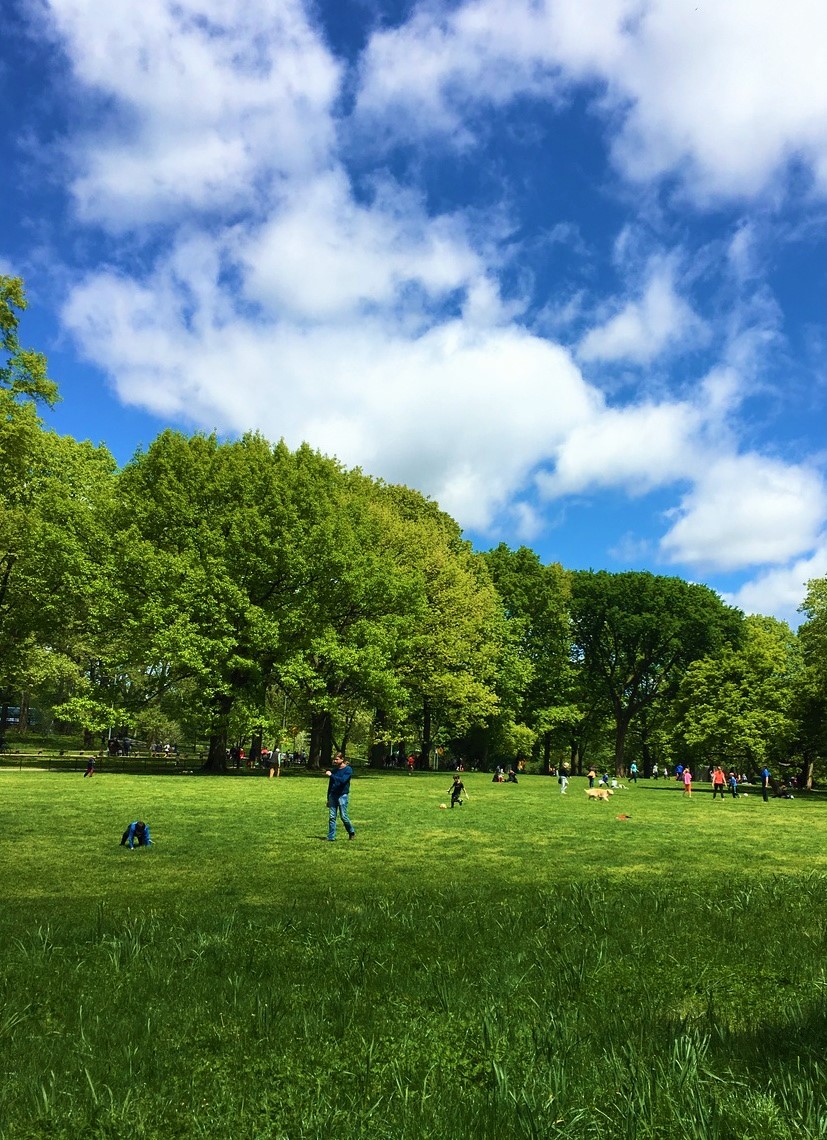
Central Park 11-36 a.m. 5-14-2017 (4).jpg

Central Park; photograph by Roger W. Smith

The winter snows, the sleigh-bells, the broken ice in the river,
passing along up or down with the flood-tide or ebb-tide”

Herman Melville, in Moby-Dick (Chapter LXXXVII), also mentions ice breaking up on the Hudson: “A low advancing hum was soon heard; and then like to the tumultuous masses of block-ice when the great river Hudson breaks up in Spring, the entire host of whales came tumbling upon their inner center. …” I myself have observed this (once) during wintertime on the Hudson. The river froze over, and I can remember the hissing and popping sounds as the ice was breaking up slowly.

“The mechanics of the city, the masters, well-form’d, beautiful-
faced, looking you straight in the eyes”

People in Manhattan — pedestrians passing — still look at you, often, with friendly eyes, not averting their gaze. There is a wonderful openness about them. The City fosters it.

Trottoirs throng’d, vehicles, Broadway”

It is still the case that the streets are thronged, with cars, pushcarts, bicycles. I love it. It drives the city traffic engineers crazy.

Trottoir is the French word for sidewalk. Whitman, who was not well versed in foreign languages, loved to use foreign words, on occasion, mostly French ones. He has been faulted for this. Some people can’t realize that one is not required to always say “sidewalk” when another word might be substituted. For various reasons, including a delight in language.

“the women, the shops and shows”

Manhattan is a wonderful place for shopping and window shopping. The “shows” continue to go on. And on. The women — a friend of mine, Charles Pierre, once remarked — are Manhattan’s “last great natural resource.” They range from classic beauties to exotic looking women with natural beauty of all backgrounds and races.

“A million people—manners free and superb—open voices—
hospitality—the most courageous and friendly young men”

This is all so true. The concentration of humanity is wonderful. The people are open and friendly.

“City of hurried and sparkling waters! city of spires and masts!
City nested in bays! my city!”

All still true, except for the “masts.” The current in the rivers is swift; they do indeed sparkle in the sunlight.


*****************************************************

Broadway.

Whitman’s Broadway would have, in the mid-1850’s, meant an area of the city below 14th Street.

“What hurrying human tides, or day or night!”

“thy side-walks wide;”
“Thou of the endless sliding, mincing, shuffling
feet!”

The sidewalks in Manhattan are indeed wide and welcoming. No thoroughfare lacks them. The pedestrian is not shunted aside or forced to walk (as is the case in the suburbs) on a faux sidewalk. The sidewalks in the City are always full of trampers, day and night.

Note: “Broadway” was originally published in the New York Herald of April 10, 1888. “Mannahatta” exists in a couple of versions published in Leaves of Grass.


— Roger W. Smith

   July 2017
Walt Whitman on autobiography


“What a gain it would be, if we could forgo some of the heavy tomes, the fruit of an age of toil and scientific study, for the simple easy truthful narrative of the existence and experience of a man of genius,—how his mind unfolded in his earliest years—the impressions things made upon him—how and where and when the religious sentiment dawned in him—what he thought of God before he was inoculated with books’ ideas—the development of his soul—when he first loved—the way circumstance imbued his nature, and did him good, or worked him ill—with the long train of occurrences, adventures, mental processes, exercises within, and trials without, which go to make up the man—for character is the man, after all.”

— Walt Whitman, review of The Autobiography of Goethe, Truth and Poetry: From My Life, The Brooklyn Daily Eagle, June 28, 1847

Walt Whitman’s prescriptions for healthy living


Walt Whitman’s health manual, “Manly Health and Training” (1858) has recently been published. It was discovered in 2012 by a graduate student at the University of Houston, Zachary Turpin.

“Manly Health and Training,” written under the pseudonym Mose Velsor, was published in installments in the New York Atlas in 1858. (Van Velsor was the maiden name of Whitman’s mother.)

Whitman’s health manifesto contains advice and musings on topics such as diet, exercise, grooming, alcohol, dancing, sports, and even sex.

“[S]ome of the advice, like the poetry, can often sound particularly modern, while at the same time preserving the quaintness of its age.” (http://www.openculture.com/2016/05/walt-whitmans-unearthed-health-manual-manly-health-training.html)

The following are some quoted passages from the book on topics addressed by Whitman where his views are in accord with my own. I was surprised to find how often this was the case.


— Roger W. Smith

   February 2017


************************************************

To spring up in the morning with light feelings, and the disposition to raise the voice in some cheerful song—to feel a pleasure in going forth into the open air, and in breathing it—to sit down to your food with a keen relish for it—to pass forth, in business or occupation, among men, without distrusting them, but with a friendly feeling toward all, and finding the same feeling returned to you—to be buoyant in all your limbs and movements by the curious result of perfect digestion, (a feeling as if you could almost fly, you are so light,)—to have perfect command of your arms, legs, &c., able to strike out, if occasion demand, or to walk long distances, or to endure great labor without exhaustion—to have year after year pass on and on, and still the same calm and equable state of all the organs, and of the temper and mentality—no wrenching pains of the nerves or joints—no pangs, returning again and again, through the sensitive head, or any of its parts—no blotched and disfigured complexion—no prematurely lame and halting gait—no tremulous shaking of the hand, unable to carry a glass of water to the mouth without spilling it—no film and bleared-red about the eyes, nor bad taste in the mouth, nor tainted breath from the stomach or gums—none of that dreary, sickening, unmanly lassitude, that, to so many men, fills up and curses what ought to be the best years of their lives, without good works to show for the same—but instead of such a living death, which, (to make a terrible but true confession,) so many lead, uncomfortably realizing, through their middle age, more than the distresses and bleak impressions of death, stretched out year after year, the result of early ignorance, imprudence, and want of wholesome training—instead of that, to find life one long holiday, labor a pleasure, the body a heaven, the earth a paradise, all the commonest habits ministering to delight—and to have this continued year after year, and old age even, when it arrives, bringing no change to the capacity for a high state of manly enjoyment—these are what we would put before you, reader, as a true picture, illustrating the whole drift of our remarks. ….


************************************************

Walking, or some form of it, is nature’s great exercise—so far ahead of all others as to make them of no account in comparison. In modern times, and among all classes of people, the cheap and rapid methods of traveling almost everywhere in vogue, have certainly made a sad depreciation in the locomotive powers of the race.

We have elsewhere mentioned the formation of the habit of walking; this is to be one of the main dependencies of the in-door employee. It does not tire, like other exercises—but, with practice, may be continued almost without limit.


************************************************

OUT-DOORS.

In that word is the great antiseptic—the true medicine of humanity … there is no withstanding the modern requirements of life, which compel myriads of men to pass a great portion of the time employed in confined places, factories and the like; and that, this being accepted, the health and vigor of the body must be carried to a high pitch, and can be. Still, it is to be understood that, as a counterweight to the effects of confined air and employment, much, very much reliance is to be placed on inhaling the air, and in walking, or otherwise gently exercising, as much as possible out-doors.

Few know what virtue there is in the open air. Beyond all charms or medications, it is what renews vitality, and, as much as the nightly sleep, keeps the system from wearing out and stagnating upon itself.


************************************************

NIGHT-EATING.

A gentle and moderate refreshment at night is admissible enough; and, indeed, if accompanied with the convivial pleasure of friends, the cheerful song, or the excitement of company, and the wholesome stimulus of surrounding good fellowship, is every way to be commended.

But it must be borne in mind that, as a general thing, the stomach needs rest as much as the other parts of the system—as much as the brain, the hands, or the feet. The arrangements of every individual, for his eating, ought to be so prepared, if possible, as to make his appetite always possess keenness and readiness in the morning. There is not a surer sign that things are going wrong than that which is indicated by no want or relish for food, soon after rising, or in the early part of the day.

Portions of heavy food, or large quantities of any kind, taken at evening, or any time during the night, attract an undue amount of the nervous energy to the stomach, and give an overaction to the feelings and powers, which is sure to be followed the next day by more or less bad reactionary consequences; and, if persevered in, must be a strong constitution indeed which does not break down.


************************************************

The drink we recommend, and– not too much of that, is water only.


************************************************

In by far the vast majority of cases, … medicines do a great deal more hurt than good … indeed, they often lay the foundation for a permanent derangement of health, destroy comfort, and shorten life.… to state the matter in plain terms, there can be very little, if any, wholesome effect produced upon almost any case of disease … from the mere taking of some more or less powerful drug into the stomach, to have whatever effect it may produce upon the bowels, blood, nerves, brain, &c. The more powerful it is, the worse it is.


************************************************

EARLY RISING.

The habit of rising early is not only of priceless value in itself, as a means toward, and concomitant of health, but is of equal importance from what the habit carries with it, apart from itself. … Summer and winter, he who intends to have his physique in good condition must rise early.

This is an immutable law. It is one of the most important points of thorough training, and is to be relied on as much as anything else.


************************************************

The game of Base-Ball, now very generally practiced, is one of the very best of out-door exercises; the same may be said of cricket—and, in short, of all games which involve the using of the arms and legs.

Walt Whitman, “A Carol Closing Sixty-Nine”


A CAROL CLOSING SIXTY-NINE.

A carol closing sixty-nine—a résumé—a repetition,
My lines in joy and hope continuing on the same,
Of ye, O God, Life, Nature, Freedom, Poetry;
Of you, my Land—your rivers, prairies, States—you, mottled
Flag I love,
Your aggregate retain’d entire—Of north, south, east and west,
your items all;
Of me myself—the jocund heart yet beating in my breast,
The body wreck’d, old, poor and paralyzed—the strange inertia
falling pall-like round me,
The burning fires down in my sluggish blood not yet extinct,
The undiminish’d faith—the groups of loving friends.

— Walt Whitman, Leaves of Grass, The Deathbed Edition, 1892


— posted by Roger W. Smith

   May 2016