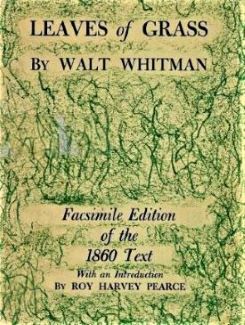
Walt Whitman’s health manual, “Manly Health and Training” (1858) has recently been published. It was discovered in 2012 by a graduate student at the University of Houston, Zachary Turpin.
“Manly Health and Training,” written under the pseudonym Mose Velsor, was published in installments in the New York Atlas in 1858. (Van Velsor was the maiden name of Whitman’s mother.)
Whitman’s health manifesto contains advice and musings on topics such as diet, exercise, grooming, alcohol, dancing, sports, and even sex.
“[S]ome of the advice, like the poetry, can often sound particularly modern, while at the same time preserving the quaintness of its age.” (http://www.openculture.com/2016/05/walt-whitmans-unearthed-health-manual-manly-health-training.html)
The following are some quoted passages from the book on topics addressed by Whitman where his views are in accord with my own. I was surprised to find how often this was the case.
— Roger W. Smith
February 2017
************************************************
To spring up in the morning with light feelings, and the disposition to raise the voice in some cheerful song—to feel a pleasure in going forth into the open air, and in breathing it—to sit down to your food with a keen relish for it—to pass forth, in business or occupation, among men, without distrusting them, but with a friendly feeling toward all, and finding the same feeling returned to you—to be buoyant in all your limbs and movements by the curious result of perfect digestion, (a feeling as if you could almost fly, you are so light,)—to have perfect command of your arms, legs, &c., able to strike out, if occasion demand, or to walk long distances, or to endure great labor without exhaustion—to have year after year pass on and on, and still the same calm and equable state of all the organs, and of the temper and mentality—no wrenching pains of the nerves or joints—no pangs, returning again and again, through the sensitive head, or any of its parts—no blotched and disfigured complexion—no prematurely lame and halting gait—no tremulous shaking of the hand, unable to carry a glass of water to the mouth without spilling it—no film and bleared-red about the eyes, nor bad taste in the mouth, nor tainted breath from the stomach or gums—none of that dreary, sickening, unmanly lassitude, that, to so many men, fills up and curses what ought to be the best years of their lives, without good works to show for the same—but instead of such a living death, which, (to make a terrible but true confession,) so many lead, uncomfortably realizing, through their middle age, more than the distresses and bleak impressions of death, stretched out year after year, the result of early ignorance, imprudence, and want of wholesome training—instead of that, to find life one long holiday, labor a pleasure, the body a heaven, the earth a paradise, all the commonest habits ministering to delight—and to have this continued year after year, and old age even, when it arrives, bringing no change to the capacity for a high state of manly enjoyment—these are what we would put before you, reader, as a true picture, illustrating the whole drift of our remarks. ….
************************************************
Walking, or some form of it, is nature’s great exercise—so far ahead of all others as to make them of no account in comparison. In modern times, and among all classes of people, the cheap and rapid methods of traveling almost everywhere in vogue, have certainly made a sad depreciation in the locomotive powers of the race.
We have elsewhere mentioned the formation of the habit of walking; this is to be one of the main dependencies of the in-door employee. It does not tire, like other exercises—but, with practice, may be continued almost without limit.
************************************************
OUT-DOORS.
In that word is the great antiseptic—the true medicine of humanity … there is no withstanding the modern requirements of life, which compel myriads of men to pass a great portion of the time employed in confined places, factories and the like; and that, this being accepted, the health and vigor of the body must be carried to a high pitch, and can be. Still, it is to be understood that, as a counterweight to the effects of confined air and employment, much, very much reliance is to be placed on inhaling the air, and in walking, or otherwise gently exercising, as much as possible out-doors.
Few know what virtue there is in the open air. Beyond all charms or medications, it is what renews vitality, and, as much as the nightly sleep, keeps the system from wearing out and stagnating upon itself.
************************************************
NIGHT-EATING.
A gentle and moderate refreshment at night is admissible enough; and, indeed, if accompanied with the convivial pleasure of friends, the cheerful song, or the excitement of company, and the wholesome stimulus of surrounding good fellowship, is every way to be commended.
But it must be borne in mind that, as a general thing, the stomach needs rest as much as the other parts of the system—as much as the brain, the hands, or the feet. The arrangements of every individual, for his eating, ought to be so prepared, if possible, as to make his appetite always possess keenness and readiness in the morning. There is not a surer sign that things are going wrong than that which is indicated by no want or relish for food, soon after rising, or in the early part of the day.
Portions of heavy food, or large quantities of any kind, taken at evening, or any time during the night, attract an undue amount of the nervous energy to the stomach, and give an overaction to the feelings and powers, which is sure to be followed the next day by more or less bad reactionary consequences; and, if persevered in, must be a strong constitution indeed which does not break down.
************************************************
The drink we recommend, and– not too much of that, is water only.
************************************************
In by far the vast majority of cases, … medicines do a great deal more hurt than good … indeed, they often lay the foundation for a permanent derangement of health, destroy comfort, and shorten life.… to state the matter in plain terms, there can be very little, if any, wholesome effect produced upon almost any case of disease … from the mere taking of some more or less powerful drug into the stomach, to have whatever effect it may produce upon the bowels, blood, nerves, brain, &c. The more powerful it is, the worse it is.
************************************************
EARLY RISING.
The habit of rising early is not only of priceless value in itself, as a means toward, and concomitant of health, but is of equal importance from what the habit carries with it, apart from itself. … Summer and winter, he who intends to have his physique in good condition must rise early.
This is an immutable law. It is one of the most important points of thorough training, and is to be relied on as much as anything else.
************************************************
The game of Base-Ball, now very generally practiced, is one of the very best of out-door exercises; the same may be said of cricket—and, in short, of all games which involve the using of the arms and legs.