R. W. B. Lewis on Whitman


Lewis, Trials of the Word


Posted here (Word document above) are excerpts from the chapter on Whitman in in R. W. B. Lewis, Trials of the Word; Essays in American Literature and the Humanistic Tradition (New Haven: Yale University Press, 1965).

Lewis’s insights are brilliant and stimulating.


— posted by Roger W. Smith

   May 2022


post updated


My post

Whitman’s Civil War years … a summary from my reading

has been updated with a brief summary of my own, as well as the addition of the chapter “Anti-Slavery Notes” [Whitman’s]  from the the book Walt Whitman’s Workshop: A Collection of Unpublished Manuscripts, edited with an introduction and notes by Clifton Joseph Furness.


— Roger W. Smith

May 2, 2023

Whitman’s Civil War years … a summary from my reading


George M. Fredrickson, The Inner Civil War

Fredrickson, ‘The Inner Civil War’ (excepts)


Gay Wilson Allen, The Solitary Singer

Allen, ‘The Solitary Singer’ (excerpts)


Horace Traubel, With Walt Whitman in Camden

from Horace Traubel, ‘With Walt Whitman in Camden’


Furness, Walt Whitman’s: Workshop: A Collection of Unpublished Manuscripts

from ‘Walt Whitman’s workshop’


Whitman, “Anti-Slavery Notes”

Whitman, ‘Anti-Slavery Notes’


CORRESPONDENCE (Walt Whitman)

correspondence


Charles I. Glicksberg, “Walt Whitman and the Negro”

Glicksberg, ‘Walt Whitman and the Negro’


Martin G. Murray, “Traveling with the Wounded: Walt Whitman and Washington’s Civil War Hospitals”

Martin G. Murray, ‘Wbitman and Washington’s Civil War Hospitals’


Ted Genoways. “Whitman and the Civil War”

Ted Genoways, ‘Whitman and the Civil War’


SUMMARY

Whitman regarded the slavery issue as secondary. It was the preservation of the Union that mattered most. “Not the negro, not the negro,” Whitman told Horace Traubel. The negro was not the chief thing: the chief thing was to stick together.”

As Charles I. Glicksberg pointed out, Whitman in his poetry nowhere denounces the evils of racial intolerance and racial discrimination. Like Lincoln, he believed that blacks were unfit to be full participants in a democracy, that they were unfit for suffrage.

To Thomas P. Sawyer, Whitman wrote: “I believe this Union will conquer in the end. … This country can’t be broken up by Jeff Davis, & all his damned crew. … life would have no charm for me, if this country should fail after all, and be reduced to take a third rate position, to be domineered over by England & France & the haughty nations of Europe &c and we unable to help ourselves. But I have no thought that will ever be, this country I hope would spend her last drop of blood, and last dollar, rather than submit to such humiliation.”

It was a common belief (and fear) that if the North were defeated, the country would be weakened and in jeopardy as an actor on the world stage.

Shortly after the battle of Bull Run, Whitman wrote the poem “Beat! Beat! Drums!,” which concludes:

Beat! beat! drums!—blow! bugles! blow!
Make no parley—stop for no expostulation,
Mind not the timid—mind not the weeper or prayer,
Mind not the old man beseeching the young man,
Let not the child’s voice be heard, nor the mother’s entreaties,
Make even the trestles to shake the dead where they lie awaiting the hearses,
So strong you thump O terrible drums—so loud you bugles blow.

Whitman began visiting wounded soldiers in New York hospitals; and after his brother George was wounded, began to do the same in hospitals in Washington, DC, to which he moved. Sympathy for the sick and discouraged made it impossible for him to leave.


— posted by Roger W. Smith

   April 2023


“Abstract yourself from this book …”


Walt Whitman, ‘Abstract yourself from this book’ (prose fragment)

PDF above.

Abstract yourself from this book; realize where you are at present located, the point you stand that is now to you the centre of all. Look up overhead, think of space stretching out, think of all the unnumbered orbs wheeling safely there, invisible to us by day, some visible by night … . Spend some minutes faithfully in this exercise. Then again realize yourself upon the earth, at the particular point you now occupy … [thinks of four directions]. Seize these firmly in your mind, pass freely over immense distances. Turn your face a moment thither. Fix definitely the direction and the idea of the distances of separate sections of your own country, also of England, the Mediterranean sea, Cape Horn, the North Pole, and such like distant places.

— Walt Whitman, “? Outset of Lecture,” IN Notebooks and Unpublished Prose Manuscripts, Volume IV, edited by Edward F. Grier ( New York University Press , 1984)

This quote from Whitman’s notes to himself is, in my opinion, highly significant – in that it reveals the type of thinking and perspective that went into the writing of his great poems, notably the early ones.

— posted by Roger W. Smith

   March 2023

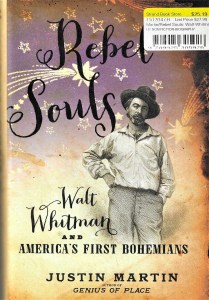
review of Justin Martin, “Rebel Souls: Walt Whitman and America’s First Bohemians”


review of ‘Rebel Souls; Walt Whitman and America’s First Bohemians’


posted here (Word document above) is a review of:

Justin Martin, Rebel Souls: Walt Whitman and America’s First Bohemians

reviewed by Stephanie M. Blalock

Walt Whitman Quarterly Review, Vol. 32, Issue 3 (winter 2015)

It is an excellent, informative review.


— posted by Roger W. Smith

   March 2023


*****************************************************

 See also my post

Walt Whitman’s watering hole


a Boston Brahmin on Whitman


In flaunting his rudeness and scorn of all refinements, Whitman aroused the class-conscious fears of such genteel critics and literary historians as Barrett Wendell, professor of English at Harvard College and personal friend of the “Boston Brahmins.” In his Literary History of America published in 1901 he could not ignore Whitman, and he gave him equal space with Longfellow and Whittier. But his sympathies were with Lowell, who “lived all his life amid the gentlest academic and social influences of America,” and Whittier, who, though of humble origin, “lived almost all of his life amid guileless influences.” But Walt Whitman, “born of the artisan class in a region close to the most considerable and corrupt centre of population on his native continent,” held a “conception of equality utterly ignoring values,” which Wendell saw as a danger to the American nation. Wendell knew that society was changing, but the increasing political power of the recent immigrants crowding the “New York slums and dingy suburban country” portended a future he could only anticipate with horror: “Those of us who love the past are far from sharing his [Whitman’s] confidence in the future.” But Barrett Wendell was an honest man, and he had to confess that the “substance of Whitman’s poems,—their imagery as distinguished from their form, or their spirit—comes wholly from our native country …. He can make you feel for the moment how even the ferry-boats plying from New York to Brooklyn are fragments of God’s eternities.’ ‘

Gay Wilson Allen, A Reader’s Guide to Walt Whitman (Syracuse University Press, 1997)

*****************************************************

Posted here (below), excerpts from Barrett Wendell, A Literary History of America (New York: Charles Scribner’s Sons, 1901), pp. 462-479

Barrett Wendell


— Roger W. Smith

   March 2023

Introduction, “The Half-Breed and Other Stories by Walt Whitman”


Introduction, ‘The Half-Breed and Other Stories’


I have obtained a rare book:

The Half-Breed and Other Stories by Walt Whitman

Collected and Edited by Thomas Ollive Mabbott

Columbia University Press, 1927

I have posted here the Introduction by the editor, Thomas Ollive Mabbott. The pages were difficult to copy due to the book’s tight binding.

The early stories by Whitman in this hook have been reprinted in Walt Whitman, The Early Poems and the Fiction, edited by Thomas L. Brasher (New York University Press, 1963).


— posted by Roger W. Smith

   March 2023

This is what you shall do …


This is what you shall do: Love the earth and sun and the ani­mals, despise riches, give alms to every one that asks, stand up for the stupid and crazy, devote your income and labor to others, hate tyrants, argue not concerning God, have patience and indul­gence toward the people, take off your hat to nothing known or unknown or to any man or number of men, go freely with pow­erful uneducated persons and with the young and with the moth­ers of families, read these leaves in the open air every season of every year of your life, re-examine all you have been told at school or church or in any book, dismiss whatever insults your own soul, and your very flesh shall be a great poem and have the richest fluency not only in words but in the silent lines of its lips and face and between the lashes of your eyes and in every motion and joint of your body.

Walt Whitman, Leaves of Grass, Preface to the first (1855) edition


— posted by Roger W. Smith

  March 2023