MANNAHATTA.
I WAS asking for something specific and perfect for my city,
Whereupon lo! upsprang the aboriginal name.
Now I see what there is in a name, a word, liquid, sane, unruly,
musical, self-sufficient,
I see that the word of my city is that word from of old,
Because I see that word nested in nests of water-bays, superb,
Rich, hemm’d thick all around with sailships and steamships, an
island sixteen miles long, solid-founded,
Numberless crowded streets, high growths of iron, slender, strong,
light, splendidly uprising toward clear skies,
Tides swift and ample, well-loved by me, toward sundown,
The flowing sea-currents, the little islands, larger adjoining islands,
the heights, the villas,
The countless masts, the white shore-steamers, the lighters, the
ferry-boats, the black sea-steamers well-model’d,
The down-town streets, the jobbers’ houses of business, the houses
of business of the ship-merchants and money-brokers, the river-streets,
Immigrants arriving, fifteen or twenty thousand in a week,
The carts hauling goods, the manly race of drivers of horses, the
brown-faced sailors,
The summer air, the bright sun shining, and the sailing clouds
aloft,
The winter snows, the sleigh-bells, the broken ice in the river,
passing along up or down with the flood-tide or ebb-tide,
The mechanics of the city, the masters, well-form’d, beautiful-
faced, looking you straight in the eyes,
Trottoirs throng’d, vehicles, Broadway, the women, the shops and
shows,
A million people—manners free and superb—open voices—
hospitality—the most courageous and friendly young men,
City of hurried and sparkling waters! city of spires and masts!
City nested in bays! my city!
*****************************************************
Broadway.
What hurrying human tides, or day or night!
What passions, winnings, losses, ardors, swim
thy waters!
What whirls of evil, bliss and sorrow stem, thee!
What curious questioning glances—glints of
love!
Leer, envy, scorn, contempt, hope, aspiration!
Thou portal—thou arena—thou of the myriad
long-drawn lines and groups!
(Could but thy flagstones, curbs, facades tell
their inimitable tales);
Thy windows, rich and huge hotels—thy side-
walks wide;
Thou of the endless sliding, mincing, shuffling
feet!
Thou, like the parti-colored world itself—like
infinite, teeming, mocking life!
Thou visor’d, vast, unspeakable show and
lesson!
****************************************************
addendum:
The following are some present day thoughts of my own occasioned by the above two poems of Walt Whitman. “Mannahatta” was Whitman’s stomping grounds during what was probably the most creative period of his life. It is my adopted city; my feelings parallel Whitman’s.
“Mannahatta”: Mannahatta is derived from the aboriginal name for the place, most likely meaning island of many hills. Whitman chose to sometimes call Manhattan “Mannahatta” and to call Long Island “Paumanok,” also derived from a Native American word.
“nested in nests of water-bays, superb,
Rich”
The fact of Manhattan’s being surrounded by water is one of its greatest and most appealing attributes. (This is also stressed by Herman Melville in the opening chapters of Moby-Dick). The rivers and bays act as a natural counterweight to urban sprawl.
“hemm’d thick all around with sailships and steamships”
Not true anymore, for the most part. Too bad. But, Manhattan Island, being bounded on all sides by water, retains a unique appeal because of this.
“an island sixteen miles long”
Sixteen miles from Battery Park (the southern tip of Manhattan Island) to Spuyten Duyvil (the northern end of the island).
“Numberless crowded streets”
Still true. Crowded, which is a blessing. You don’t find lonely, deserted spots or forsaken places. Crowed, yes, but the crowds usually aren’t oppressive.
“high growths of iron, slender, strong,
light, splendidly uprising toward clear skies”
Space is limited in Manhattan. Tall buildings reaching to the skies create a sense of awe.
“Tides swift and ample, well-loved by me, toward sundown,
The flowing sea-currents, the little islands, larger adjoining islands,
the heights, the villas”
Still true. There are islands, rivers with eddies, great vistas. All can still be seen by someone who strolls along the East River, the Battery, the banks of the Hudson, or the rarely visited but wonderful stretches of parkland at the upper tip of the island.
“the lighters, the ferry-boats”
Ferries still run, to the delight and for the convenience of many. A lighter is a barge used in unloading or loading ships. In one of Whitman’s greatest poems, “Crossing Brooklyn Ferry,” there is a reference to a “belated lighter.”
“The down-town streets, the jobbers’ houses of business, the houses
of business of the ship-merchants and money-brokers, the river-streets”
The small businesses are mostly gone, but there are still “river-streets.” Yet, access to the rivers is not so convenient anymore, since highways on the East and West Sides impede (but do not entirely prevent) access.
“Immigrants arriving, fifteen or twenty thousand in a week”
New York is still a city of immigrants, thank God. Mostly immigrants speaking, it seems, practically every imaginable tongue.
“The carts hauling goods, the manly race of drivers of horses”
Whitman loved to ride with and become acquainted with the drivers of horse drawn omnibuses on the main thoroughfares of Manhattan.
“The summer air, the bright sun shining, and the sailing clouds aloft”
So true, still. See photo below.
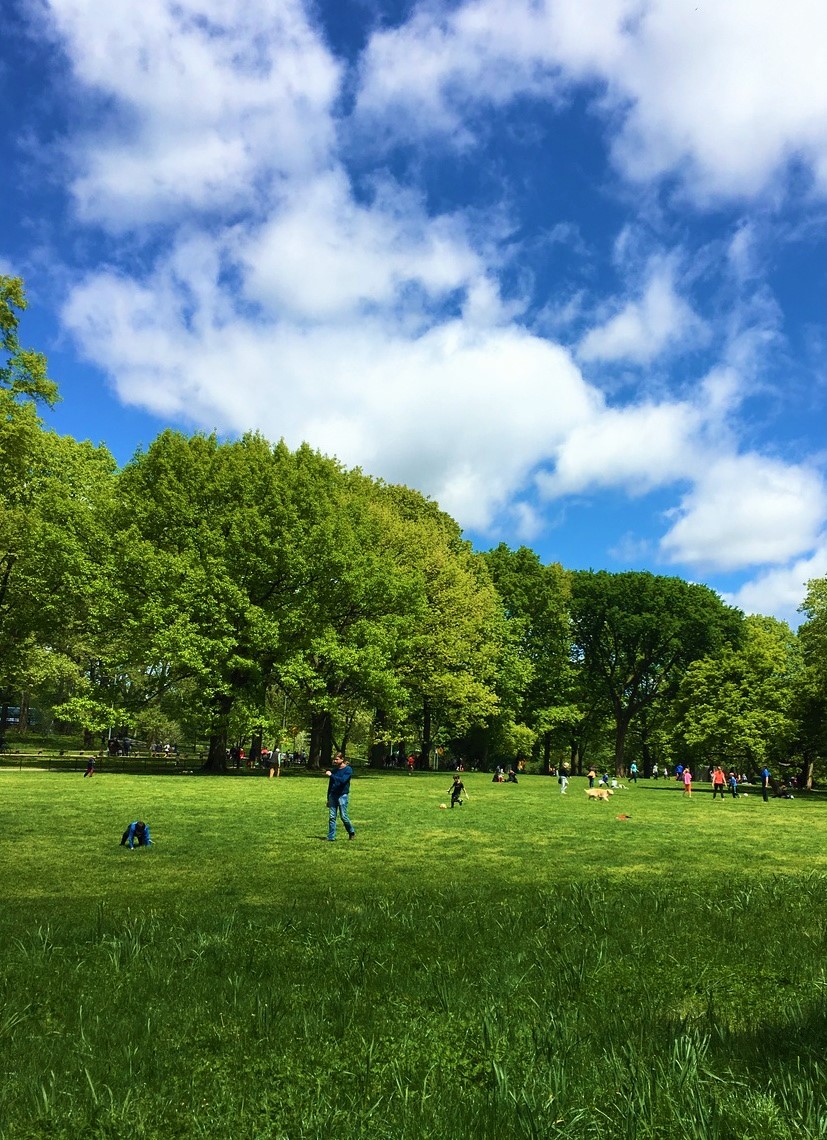
Central Park; photograph by Roger W. Smith
The winter snows, the sleigh-bells, the broken ice in the river,
passing along up or down with the flood-tide or ebb-tide”
Herman Melville, in Moby-Dick (Chapter LXXXVII), also mentions ice breaking up on the Hudson: “A low advancing hum was soon heard; and then like to the tumultuous masses of block-ice when the great river Hudson breaks up in Spring, the entire host of whales came tumbling upon their inner center. …” I myself have observed this (once) during wintertime on the Hudson. The river froze over, and I can remember the hissing and popping sounds as the ice was breaking up slowly.
“The mechanics of the city, the masters, well-form’d, beautiful-
faced, looking you straight in the eyes”
People in Manhattan — pedestrians passing — still look at you, often, with friendly eyes, not averting their gaze. There is a wonderful openness about them. The City fosters it.
“Trottoirs throng’d, vehicles, Broadway”
It is still the case that the streets are thronged, with cars, pushcarts, bicycles. I love it. It drives the city traffic engineers crazy.
Trottoir is the French word for sidewalk. Whitman, who was not well versed in foreign languages, loved to use foreign words, on occasion, mostly French ones. He has been faulted for this. Some people can’t realize that one is not required to always say “sidewalk” when another word might be substituted. For various reasons, including a delight in language.
“the women, the shops and shows”
Manhattan is a wonderful place for shopping and window shopping. The “shows” continue to go on. And on. The women — a friend of mine, Charles Pierre, once remarked — are Manhattan’s “last great natural resource.” They range from classic beauties to exotic looking women with natural beauty of all backgrounds and races.
“A million people—manners free and superb—open voices—
hospitality—the most courageous and friendly young men”
This is all so true. The concentration of humanity is wonderful. The people are open and friendly.
“City of hurried and sparkling waters! city of spires and masts!
City nested in bays! my city!”
All still true, except for the “masts.” The current in the rivers is swift; they do indeed sparkle in the sunlight.
*****************************************************
Broadway.
Whitman’s Broadway would have, in the mid-1850’s, meant an area of the city below 14th Street.
“What hurrying human tides, or day or night!”
“thy side-walks wide;”
“Thou of the endless sliding, mincing, shuffling
feet!”
The sidewalks in Manhattan are indeed wide and welcoming. No thoroughfare lacks them. The pedestrian is not shunted aside or forced to walk (as is the case in the suburbs) on a faux sidewalk. The sidewalks in the City are always full of trampers, day and night.
Note: “Broadway” was originally published in the New York Herald of April 10, 1888. “Mannahatta” exists in a couple of versions published in Leaves of Grass.
— Roger W. Smith
July 2017
 Roger W. Smith's Walt Whitman site