Horace Traubel, Preface; With Walt Whitman in Camden
Posted here (PDF above):
Horace Traubel
Preface to Walt Whitman in Camden, Volume 1, March 28-July 14, 1888 (New York: Rowman and Littlefield, Inc. 1961)
— posted by Roger W. Smith
September 2024
Horace Traubel, Preface; With Walt Whitman in Camden
Posted here (PDF above):
Horace Traubel
Preface to Walt Whitman in Camden, Volume 1, March 28-July 14, 1888 (New York: Rowman and Littlefield, Inc. 1961)
— posted by Roger W. Smith
September 2024
My post
has been updated with a brief summary of my own, as well as the addition of the chapter “Anti-Slavery Notes” [Whitman’s] from the the book Walt Whitman’s Workshop: A Collection of Unpublished Manuscripts, edited with an introduction and notes by Clifton Joseph Furness.
— Roger W. Smith
May 2, 2023
George M. Fredrickson, The Inner Civil War
Fredrickson, ‘The Inner Civil War’ (excepts)
Gay Wilson Allen, The Solitary Singer
Allen, ‘The Solitary Singer’ (excerpts)
Horace Traubel, With Walt Whitman in Camden
from Horace Traubel, ‘With Walt Whitman in Camden’
Furness, Walt Whitman’s: Workshop: A Collection of Unpublished Manuscripts
from ‘Walt Whitman’s workshop’
Whitman, “Anti-Slavery Notes”
CORRESPONDENCE (Walt Whitman)
Charles I. Glicksberg, “Walt Whitman and the Negro”
Glicksberg, ‘Walt Whitman and the Negro’
Martin G. Murray, “Traveling with the Wounded: Walt Whitman and Washington’s Civil War Hospitals”
Martin G. Murray, ‘Wbitman and Washington’s Civil War Hospitals’
Ted Genoways. “Whitman and the Civil War”
Ted Genoways, ‘Whitman and the Civil War’
SUMMARY
Whitman regarded the slavery issue as secondary. It was the preservation of the Union that mattered most. “Not the negro, not the negro,” Whitman told Horace Traubel. The negro was not the chief thing: the chief thing was to stick together.”
As Charles I. Glicksberg pointed out, Whitman in his poetry nowhere denounces the evils of racial intolerance and racial discrimination. Like Lincoln, he believed that blacks were unfit to be full participants in a democracy, that they were unfit for suffrage.
To Thomas P. Sawyer, Whitman wrote: “I believe this Union will conquer in the end. … This country can’t be broken up by Jeff Davis, & all his damned crew. … life would have no charm for me, if this country should fail after all, and be reduced to take a third rate position, to be domineered over by England & France & the haughty nations of Europe &c and we unable to help ourselves. But I have no thought that will ever be, this country I hope would spend her last drop of blood, and last dollar, rather than submit to such humiliation.”
It was a common belief (and fear) that if the North were defeated, the country would be weakened and in jeopardy as an actor on the world stage.
Shortly after the battle of Bull Run, Whitman wrote the poem “Beat! Beat! Drums!,” which concludes:
Beat! beat! drums!—blow! bugles! blow!
Make no parley—stop for no expostulation,
Mind not the timid—mind not the weeper or prayer,
Mind not the old man beseeching the young man,
Let not the child’s voice be heard, nor the mother’s entreaties,
Make even the trestles to shake the dead where they lie awaiting the hearses,
So strong you thump O terrible drums—so loud you bugles blow.
Whitman began visiting wounded soldiers in New York hospitals; and after his brother George was wounded, began to do the same in hospitals in Washington, DC, to which he moved. Sympathy for the sick and discouraged made it impossible for him to leave.
— posted by Roger W. Smith
April 2023

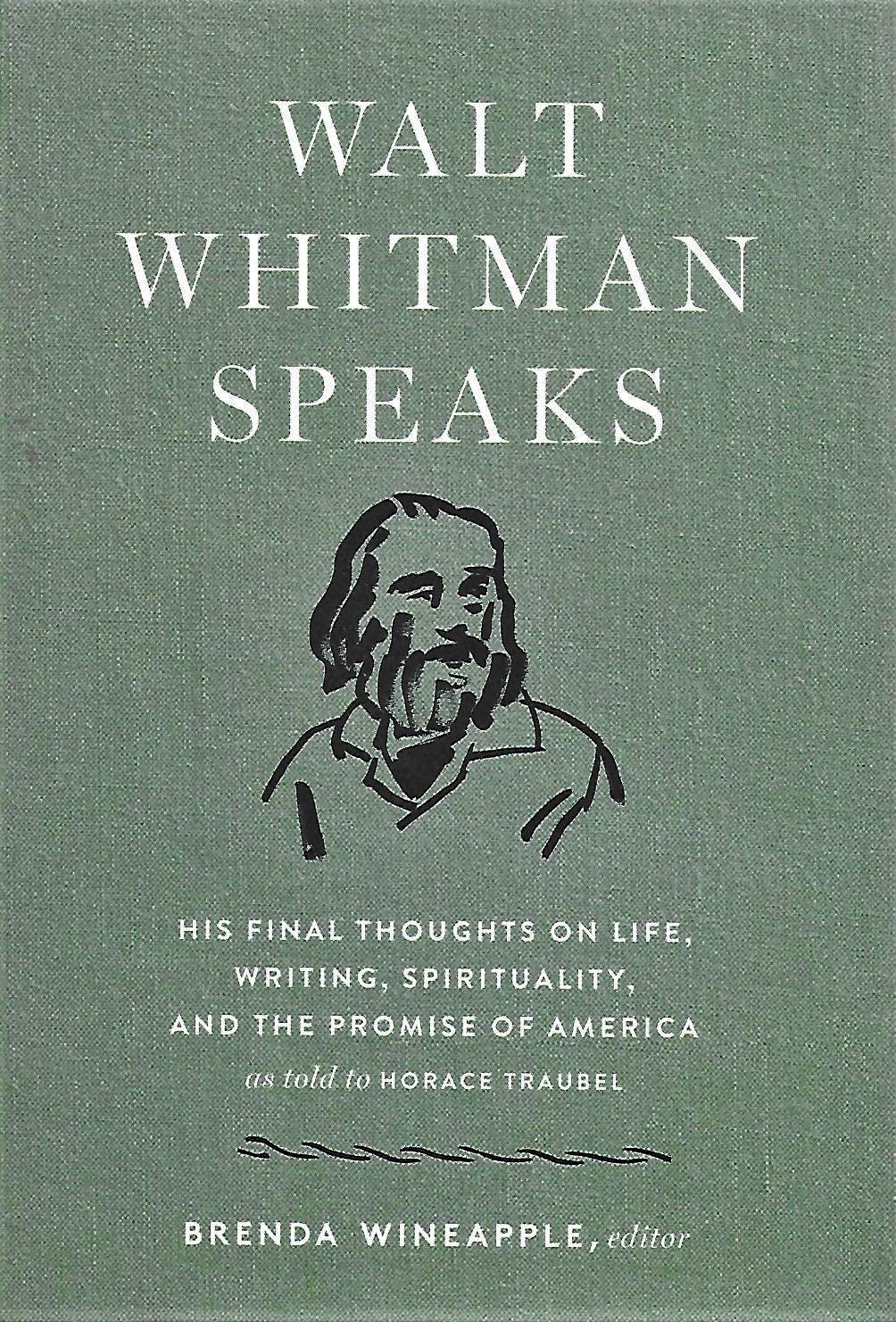
I purchased yesterday at the Stand Bookstore the following slim book:
Walt Whitman Speaks: His Final Thoughts on Life, Writing, Spirituality, and the Promise of America
as told to Horace Traubel
edited and with an introduction by Brenda Wineapple
New York: Library of America, 2019
Whitman’s remarks are grouped, arranged, by topic.
They are all taken from With Walt Whitman in Camden by Whitman’s friend and acolyte Horace Traubel. Nowhere in the present volume is there any indication of on what DATE the conversation with Traubel occurred (all of which is fully indicted in the nine volumes of Traubel’s).
In James Boswell’s Life of Johnson, the date on which a conversation with Johnson occurred is an important consideration, and was duly noted by Boswell. Same thing here (regarding the importance of dating when the remark was made).
What was Brenda Wineapple thinking? She is an accomplished and well known American literary scholar. I blame her, and also the Library of America.
Whitman scholars will be disappointed.
— Roger W. Smith
May 2019
 Roger W. Smith's Walt Whitman site