Tag Archives: Roger Smith

“See, in my poems” (Walt Whitman)


excerpt 2 from ‘Starting from Paumanok’


See! steamers steaming through my poems!
See, in my poems immigrants continually coming and landing;
See, in arriere, the wigwam, the trail, the hunter’s hut, the flat-
boat, the maize-leaf, the claim, the rude fence, and the
backwoods village;
See, on the one side the Western Sea, and on the other the Eastern Sea, how they advance and
retreat upon my poems,
as upon their own shores;
See, pastures and forests in my poems—see, animals, wild and
tame—See, beyond the Kanzas, countless herds of buffalo,
feeding on short curly grass;
See, in my poems, cities, solid, vast, inland, with paved streets,
with iron and stone edifices, ceaseless vehicles, and
commerce;
See, the many-cylinder’d steam printing-press—see, the electric
telegraph, stretching across the continent, from the Western Sea
to Manhattan;
See, through Atlantica’s depths, pulses American, Europe
reaching—pulses of Europe, duly return’d,
See, the strong and quick locomotive, as it departs, panting,
blowing the steam-whistle;
See, ploughmen, ploughing farms—See, miners, digging mines—
see, the numberless factories;
See, mechanics, busy at their benches, with tools—see from
among them, superior judges, philosophs, Presidents, emerge,
drest in working dresses;
See, lounging through the shops and fields of The States, me,
well-belov’d, close-held by day and night;
Hear the loud echoes of my songs there! Read the hints come at
last.

Walt Whitman,. “Starting from Paumanok.” (excerpt)


– posted by Roger W. Smith

   August 2020

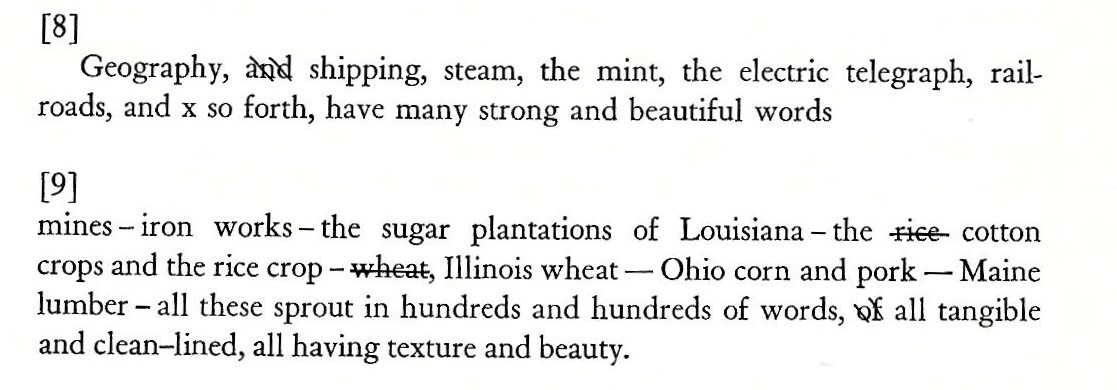
Walt Whitman creates a catalogue


Walt Whitman: Daybooks and Notebooks, edited by William White, Volume III, pg. 733 (New York University Press, 1978)


Interlink’ d, food-yielding lands!
Land of coal and iron! land of gold! land of cotton, sugar, rice! Land of wheat, beef, pork! land of wool and hemp! land of the
apple and the grape!
Land of the pastoral plains, the grass-fields of the world! land of
those sweet-air’d interminable plateaus!
Land of the herd, the garden, the healthy house of adobie! Lands where the north-west Columbia winds, and where the
south-west Colorado winds!
Land of the eastern Chesapeake! land of the Delaware!
Land of Ontario, Erie, Huron, Michigan!
Land of the Old Thirteen! Massachusetts land! land of Vermont
and Connecticut!
Land of the ocean shores! land of sierras and peaks!

— from Walt Whitman, “Starting from Paumanok”


excerpt from ‘Starting from Paumanok’


*****************************************************

Walt Whitman’s catalogues. Long lists. A stylistic feature of his poetry.


posted by Roger W. Smith

  August 2020

Walt Whitman (again)


from ‘There was a child went forth’


The streets themselves and the facades of houses, and goods in
the windows,
Vehicles, teams, the heavy-plank’d wharves, the huge crossing
at the ferries,
The village on the highland seen from afar at sunset, the river
between,
Shadows, aureola and mist, the light falling on roofs and gables
of white or brown two miles off,
The schooner near by sleepily dropping down the tide, the little
boat slack-tow’ d astern,
The hurrying tumbling waves, quick-broken crests, slapping,
The strata of color’d clouds, the long bar of maroon-tint away
solitary by itself, the spread of purity it lies motionless in,
The horizon’s edge, the flying sea- crow, the fragrance of salt
marsh and shore mud,
These became part of that child who went forth every day, and
who now goes, and will always go forth every day.

— from Walt Whitman, “There Was a Child Went Forth” (1855)


*****************************************************

As noted by James Perrin Warren in his monograph Walt Whitman’s Language Experiment, “This passage catalogues the scenes of New York and Brooklyn, scenes that will become central to later poems like ‘Crossing Brooklyn Ferry;’ ‘Out of the Cradle Endlessly Rocking;’ and ‘As I Ebb’d with the Ocean of Life.’ ”

The beautiful passage evokes images and thoughts of New York City which I can relate to.


Roger W. Smith

   August 2020

the poet (Walt Whitman)


Walt Whtiman, from ‘Song of the Broad Axe’


His shape arises!
Arrogant, masculine, naive, rowdyish,
Laugher, weeper, worker, idler, citizen, country-man,
Saunterer of woods, stander upon hills, summer swimmer in
rivers or by the sea,
Of pure American breed, of reckless health, his body perfect,
free from taint from top to toe, free forever from headache
and dyspepsia, clean-breathed,
Ample-limbed, a good feeder, weight a hundred and eighty
pounds, full-blooded, six feet high, forty Inches round the
breast and back,
Countenance sun-burnt, bearded, calm, unrefined,
Reminder of animals, meeter of savage and gentleman on equal
terms,
Attitudes lithe and erect, costume free, neck open, of slow
movement on foot,
Passer of his right arm round the shoulders of his friends,
companion of the street,
Persuader always of people to give him their sweetest touches,
and never their meanest,
A Manhattanese bred, fond of Brooklyn, fond of Broadway, fond
of the life of the wharves and the great ferries,
Enterer everywhere, welcomed everywhere, easily understood
after all,
Never offering others, always offering himself, corroborating his
phrenology,
Voluptuous, inhabitive, combative, conscientious, alimentive,
intuitive, of copious friendship, sublimity, firmness, self-
esteem, comparison, individuality, form, locality, eventuality,
Avowing by life, manners, works, to contribute illustrations of
results of The States,
Teacher of the unquenchable creed, namely, egotism,
Inviter of others continually henceforth to try their strength
against his.

— Walt Whitman, “Song of the Broad-Axe” (1856 version)


*****************************************************

For a discussion of this passage — and of Whitman’s brilliant use of –er nouns, formed from adding suffixes to verbs — see James Perrin Warren, Walt Whitman’s Language Experiment (The Pennsylvania State University Press, 1990), pp. 56-57,

Note Whitman’s genius in creating his own “grammar” in which the repetition of these nouns functions to create what the Whitman scholar Gay Wilson Allen* (drawing upon the work of the Italian scholar Pasquale Jannaccone, in his La Poesìa di Walt Whitman e L’Evoluzione delle Forme Ritmìche) calls “grammatical and logical rime.”


*Gay Wilson Allen, Walt Whitman Handbook (Packard and Company, 1946), pg. 408


*****************************************************

My former therapist, Dr. Ralph Colp. Jr. said, exclaimed, to me once, that Walt Whitman was a wonderful, a marvelous, PERSON. How true. How much I would like to be able to say I partook of some of these personal qualities.

— Roger W. Smith

   August 2020

the beauty of Walt Whitman’s images


the beauty of Whitman’s images


This post is in the format of a 20-page essay (downloadable Word document above).

My essay is entitled “The Beauty of Walt Whitman’s Images.”


from the introduction:

I have become well acquainted with Walt Whitman’s Leaves of Grass through repeated readings — I have committed many lines to memory. From familiarity — and, I suppose one would say, the spiritual comfort Whitman’s poetry gives me — Leaves of Grass has become a sort of Bible for me.

Below is a compilation by me of striking, beautiful, brilliant — so original, and often unique — images that I have culled from Leaves of Grass. I think they prove that Whitman, who is deliberately and studiously non-literary — without affectation and without using common poetic tropes — constantly infuses his poetry with images of startling beauty. That’s the best way I know how to put it.


— posted by Roger W. Smith

   June 2020

“Sing on! you gray-brown bird”


“Sing on! you gray-brown bird”

movement eight from When Lilacs Last in the Dooryard Bloom’d: A Requiem for those we love

composed by Paul Hindemith.

text from Walt Whitman’s poem of the same name

Words and music fitting for our present time.


*****************************************************

Sing on, sing on you gray-brown bird,
Sing from the swamps, the recesses, pour your chant from the
bushes,
Limitless out of the dusk, out of the cedars and pines.

Sing on dearest brother, warble your reedy song,
Loud human song, with voice of uttermost woe.

O liquid and free and tender!
O wild and loose to my soul—O wondrous singer!
You only I hear—yet the star holds me, (but will soon depart,)
Yet the lilac with mastering odor holds me.

Now while I sat in the day and look’d forth,
In the close of the day with its light and the fields of spring, and
the farmers preparing their crops,
In the large unconscious scenery of my land with its lakes and
forests,
In the heavenly aerial beauty, (after the perturb’d winds and the
storms,)
Under the arching heavens of the afternoon swift passing, and the
voices of children and women,
The many-moving sea-tides, and I saw the ships how they
sail’d,
And the summer approaching with richness, and the fields all busy
with labor,
And the infinite separate houses, how they all went on, each with
its meals and minutia of daily usages,
And the streets how their throbbings throbb’d, and the cities pent
—lo, then and there,
Falling upon them all and among them all, enveloping me with the
rest,
Appear’d the cloud, appear’d the long black trail,
And I knew death, its thought, and the sacred knowledge of
death.

Then with the knowledge of death as walking one side of me,
And the thought of death close-walking the other side of me,
And I in the middle as with companions, and as holding the
hands of companions,
I fled forth to the hiding receiving night that talks not,
Down to the shores of the water, the path by the swamp in the
dimness,
To the solemn shadowy cedars and ghostly pines so still.

And the singer so shy to the rest receiv’d me,
The gray-brown bird I know receiv’d us comrades three,
And he sang the carol of death, and a verse for him I love.

From deep secluded recesses,
From the fragrant cedars and the ghostly pines so still,
Came the carol of the bird.

And the charm of the carol rapt me,
As I held as if by their hands my comrades in the night,
And the voice of my spirit tallied the song of the bird.

*****************************************************

“I will try to remain calm. I will try to concentrate my attention on the sound of the wind and the buzzing of the bees outside my window, the scent of the hoya blossom, … and the sight of the cherry trees in bloom.” — Ella Rutledge, March 30, 2020


posted by Roger W. Smith

   April 2020

a letter from Walt Whitman


What interests me about the letter of Walt Whitman posted here (text below) is his feelings about his native city, New York. They are similar to mine.

Whitman, then working as government clerk and a volunteer in hospitals in Washington, DC, was visiting New York at the time the letter was written. He was staying at his mother’ s house on Portland Avenue in Brooklyn.

— Roger W. Smith

   June 2019


*****************************************************

Monday forenoon November 9 [1863]

Dear comrades, as I did not finish my letter yesterday afternoon, as I had many friends come to see me, I will finish it now—the news this morning is that Meade is shoving Lee back upon Richmond, & that we have already given the rebs some hard knocks, there on the old Rappahannock fighting ground. O I do hope the Anny of the Potomac will at last gain a first-class victory, for they have had to retreat often enough, &: yet I believe a better Army never trod the earth than they are & have been for over a year.

Well, dear comrades, it looks so different here in all this mighty city, every thing going with a big rush & so gay, as if there was neither war nor hospitals in the land. New York &: Brooklyn appear nothing but prosperity & plenty. Every where carts & trucks & carriages & vehicles on the go, loaded with goods, express-wagons, omnibuses, cars, &c—thousands of ships along the wharves, & the piers piled high, where they are loading or unloading the cargoes—all the stores crammed with every thing you can think of, & the markets with all sorts of provisions—tens & hundreds of thousands of people every where, (the population is 1,500,000) , almost every body well-drest, & appearing to have enough—then the splendid river & Harbor here, full of ships, steamers, sloops, &c—then the great street, Broadway, for four miles, one continual jam of people, & the great magnificent stores all along on each side, & the show windows filled with beautiful & costly goods—I never saw the crowd thicker, nor such goings on & such prosperity [italics added]—& as I passed through Baltimore.& Philadelphia it seemed to be just the same.

I am quite fond of crossing on the Fulton ferry, or South ferry, between Brooklyn & New York, on the big handsome boats. They run continually day & night. I know most of the pilots, & I go up on deck & stay as long as I choose. The scene is very curious, & full of variety. The shipping along the wharves looks like a forest of bare trees. Then there are all classes of sailing vessels & steamers, some of the grandest & most beautiful steamships in the world, going or coming from Europe, or on the California route, all these on the move. As I sit up there in the pilot house, I can see every thing, & the distant scenery, & away down toward the sea, & Fort Lafayette &c. The ferry boat has to pick its way through the crowd. Often they hit each other, then there is a time—

My loving comrades I am scribbling this in my room in my Mother’s house. …

— Walt Whitman, The Correspondence: Volume I: 1842-1867, edited by Edwin Haviland Miller (New York University Press, 1961), pp. 180-181

Walt Whitman … profoundly a New Yorker


In his sprawl, his vaunting ambition, and his humanity, Walt Whitman was profoundly a New Yorker. His poetry bore no little resemblance to the “mettlesome, mad, extravagant city” that he called home, and to the end of his life, he remained “a Manhattanese, free, friendly and proud.”

Whitman was born in the small community of West Hills in Suffolk County, and he returned often to the rural scenes of “fish-shape Paumanok,” as he called Long Island. But he grew up in Brooklyn, at a time when it was growing explosively, and proudly called himself a “Brooklyn boy.” Like his father, he found occasional work in carpentry and contracting, and that may have affected the way he thought about his poetry–with “the preparatory jointing, squaring, sawing, mortising, the hoist-up of beams the push of them in their places, laying them regular.”

New York’s expansion resembled Whitman’s own during the “seed-time years” that preceded Leaves of Grass. He later claimed that the poems “arose out of my life in Brooklyn and New York from 1838 to 1853, absorbing a million people, for fifteen years, with an intimacy, an eagerness, and an abandon, probably never equaled.” Although he moved to Washington during the Civil War and then to Camden, New Jersey, he never stopped revisiting the New York of his imagination. In a letter from 1868, he wrote, “I sometimes think I am the particular man who enjoys the shows of all these things in New York more than any other mortal–as if it was all got up just for me to observe and study.” [italics added]

– exhibit label, “Walt Whitman: Bard of Democracy”; exhibition at the Morgan Library, New York, NY


*****************************************************

CITY OF SHIPS.

CITY of ships!
(O the black ships! O the fierce ships!
O the beautiful sharp-bow’d steam-ships and sail-ships!)
City of the world! (for all races are here,
All the lands of the earth make contributions here;)
City of the sea! city of hurried and glittering tides!
City whose gleeful tides continually rush or recede, whirling in and out with eddies and foam!
City of wharves and stores—city of tall façades of marble and iron!
Proud and passionate city—mettlesome, mad, extravagant city!
Spring up O city—not for peace alone, but be indeed yourself, warlike!
Fear not—submit to no models but your own O city!
Behold me—incarnate me as I have incarnated you!
I have rejected nothing you offer’d me—whom you adopted I have adopted,
Good or bad I never question you— love all—I do not condemn any thing,
I chant and celebrate all that is yours—yet peace no more,
In peace I chanted peace, but now the drum of war is mine,
War, red war is my song through your streets, O city!

Leaves of Grass (1881-1882)


*****************************************************

But I was a Manhattanese, free, friendly, and proud
I was called by my nighest name by clear loud voices
of young men as they saw me approaching or passing,
Felt their arms on my neck as I stood, or the negligent leaning of their flesh against me as I sat,
Saw many I loved in the street, or ferry-boat, or public assembly, yet never told them a word,
Lived the same life with the rest, the same old laughing, gnawing, sleeping,
Played the part that still looks back on the actor or actress,
The same old rôle, the rôle that is what we make it, as great as we like,
Or as small as we like, or both great and small.

— Walt Whitman, “Crossing Brooklyn Ferry” (excerpt)\


*****************************************************

The house-builder at work in cities or anywhere,
The preparatory jointing, squaring, sawing, mortising,
The hoist-up of beams, the push of them in their places,
laying them regular

— Walt Whitman, “Song of the Broad-Axe” (excerpt)


*****************************************************

The exhibit label is vague about where Whitman actually lived during his years in what now comprises New York City. (Brooklyn and Manhattan were separate municipalities when Whitman lived there. Jamaica, Queens, where Whitman was a schoolteacher briefly, was then part of Long Island, where Whitman was born.) He grew up in Brooklyn; and, in the years of his adulthood prior to the Civil War, he resided in both Brooklyn and Manhattan at various times. When in Manhattan, he lived downtown in boarding houses in or near what is now the Financial District. When he was residing in Brooklyn, he often took the ferry to Manhattan. He was a regular at Pfaff’s beer cellar in Manhattan, which was located on Broadway near Bleecker Street.

Whitman lived on Ryerson Street in Brooklyn in the 1850s.


*****************************************************

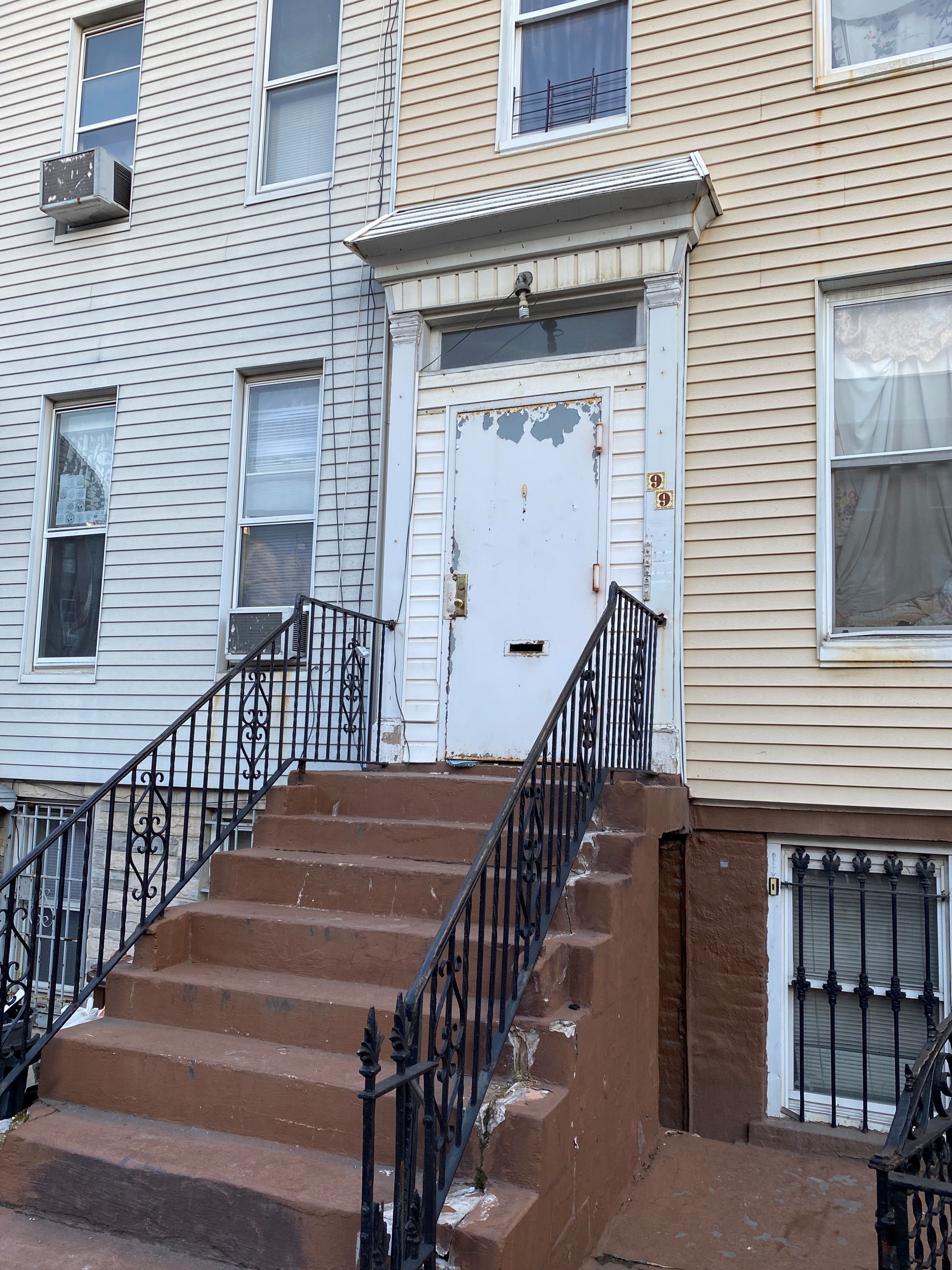
photos by Roger W. Smith

former Whitman home, 99 Ryerson Street, Brooklyn (Clinton Hill Section)

99 Ryerson Street

*****************************************************

See:

“Should Walt Whitman’s House Be Landmarked? It’s Complicated: The city does not think so, and the building’s owner agrees. Then there’s the matter of whether the poet should be honored in such a diverse neighborhood.,” By Jane Margolies,  The New York Times, December 24, 2019

‘Should Walt Whitman House Be Landmarked’ – NY Times 12-24-2019


— posted by Roger W. Smith


*****************************************************

Addendum:

In 2017, University of Iowa Press published a lost Whitman novel (its existence was unknown to scholars):  Life and Adventures of Jack Engle, which was originally published by Whitman in 1852 under a pseudonym and was serialized in a New York newspaper, the Sunday Dispatch. Zachary Turpin, who wrote an introduction to the 2017 edition, made this remarkable discovery.

If one reads the novel, which is set in Manhattan at around the time of Whitman’s boyhood — i.e., the early nineteenth century —  one can readily perceive Whitman’s familiarity with the City, which provides a setting and backdrop for the events and gives the story verisimilitude.

how could she omit the dates? (Whitman scholars won’t be happy)


'Walt Whitman Speaks' -book cover


I purchased yesterday at the Stand Bookstore the following slim book:

Walt Whitman Speaks: His Final Thoughts on Life, Writing, Spirituality, and the Promise of America

as told to Horace Traubel

edited and with an introduction by Brenda Wineapple

New York: Library of America, 2019

Whitman’s remarks are grouped, arranged, by topic.

They are all taken from With Walt Whitman in Camden by Whitman’s friend and acolyte Horace Traubel. Nowhere in the present volume is there any indication of on what DATE the conversation with Traubel occurred (all of which is fully indicted in the nine volumes of Traubel’s).

In James Boswell’s Life of Johnson, the date on which a conversation with Johnson occurred is an important consideration, and was duly noted by Boswell. Same thing here (regarding the importance of dating when the remark was made).

What was Brenda Wineapple thinking? She is an accomplished and well known American literary scholar. I blame her, and also the Library of America.

Whitman scholars will be disappointed.


— Roger W. Smith

    May 2019

Walt Whitman: simplicity and complexity


“No one makes craft, carefully wrought, seem more casual than Walt Whitman.”

— Richard Rhodes, How to Write: Advice and Reflections (New York: William Morrow and Company, 1995), pg. 12


A former friend of mine, the poet Charles Pierre, made a comment to me — I wish I could remember exactly what he said — to the effect that Walt Whitman is actually very difficult. Difficult for the reader, that is. That he presents a level of difficulty that requires acute understanding of? I think Pierre would have said: an understanding of what Whitman is doing; of his poetic technique, of his originality, poetic genius, and ingenuity. That Whitman, who seems on the surface so simple, is not really simple.

And yet, I find Whitman to be easy to become acquainted with and comprehend without necessarily being (as in the case of myself) expert at poetry. I “got” his poetry almost right away.

— Roger W. Smith

   February 2019