On my Sorokin site, I have a new post: an early article that the sociologist and social philosopher Pitirim A. Sorokin wrote about Walt Whitman, which I have translated from the original Russian.
Posted at
— Roger W. Smith
On my Sorokin site, I have a new post: an early article that the sociologist and social philosopher Pitirim A. Sorokin wrote about Walt Whitman, which I have translated from the original Russian.
Posted at
— Roger W. Smith
Walt Whitman -NY Times 3-12-1865 pg 5
The attached is a PDF of an article by Walt Whitman in The New York Times of April 12, 1865.
Note the hints (foreshadowings) of Whitman’s “When Lilacs Last in the Dooryard Bloom’d.” “The Western Star, in the earlier hours of the evening, has never been so large, so clear; it seems as if it told something, as if it held rapport indulgent with humanity, with us Americans.”
— posted by Roger W. Smith
July 2021
Robert G. Ingersoll, ‘Address at the Funeral of Walt Whitman’
Posted here (downloadable PDF document above) is Robert G. Ingersoll’s eulogy for Walt Whitman, which was delivered on March 30, 1892 at Harleigh Cemetery in Camden, New Jersey.
*****************************************************
Robert G. Ingersoll (1833-1899) was an American lawyer, writer, and orator. Known as “The Great Agnostic,” Ingersoll was a staunch advocate of free thought.
Ingersoll was a close friend of Walt Whitman. They had profound admiration for one another, as can be seen by anyone who reads Horace Traubel’s multivolume work With Walt Whitman in Camden. “It should not be surprising that I am drawn to Ingersoll, for he is ‘Leaves of Grass’ … He lives, embodies, the individuality, I preach. I see in Bob [Ingersoll] the noblest specimen–American-flavored–pure out of the soil, spreading, giving, demanding light,” Whitman told Traubel.
— posted by Roger W. Smith
March 2021
Our City
NEW YORK is a great place — a mighty world in itself. Strangers who come here for the first time in their lives, spend week after week, and yet find that there are still hundreds of wonders and surprises, and (to them) oddities, which they have not had a chance of examining. Here are people of all classes and stages of rank — from all countries on the globe — engaged in all the varieties of avocations — of every grade, every hue of ignorance and learning, morality and vice, wealth and want, fashion and coarseness, breeding and brutality, elevation and degradation, impudence and modesty.
Coming up Broadway, from the Bowling Green, an observer will notice, on each side, tall, quiet looking houses, with no great aspect of life or business. These are mostly boarding houses; and notwithstanding their still look, they no doubt contain within their walls no small number of occupants. Here the sidewalks and the street present hut few passengers. After passing Trinity Church, however, the crowd thickens, and the ground stories of the buildings are principally occupied as shops. Along this section of Broadway are several crack hotels. If you pass at the latter part of the day, you will see little groups of well dressed men, picking their teeth lazily, and enjoying an after dinner lounge. Near here, there are two shops which deserve especial notice. Judging by their capacious windows, they are for the sale of knicknacks, and fancy articles of all descriptions, from a chess board or an escritoire to a toothpick. From a glance at these treasures, a person can hardly help reflecting how many thousand wants, altogether imaginary, one may he led to have through the refinements of civilization.
Directly afterward, you will notice two crowds gazing at the prints in the windows of a book store. This is Colman’s. If you chance to stop there for the same purpose as the rest, look out for the contents of your pockets. We mean this in a double sense; for if you are not incited to purchase some of the alluring literary beauties to be had at Colman’s, it is quite possible that you may he otherwise relieved of your cash by some of the swells who there do congregate.
Then you come to where the Park thrusts out as a kind of wedge between Broadway and the beginning of Park Row. If you take the left, you have to make way against a great current of fashion, idleness, and foppery. Suppose you turn to the right.
Down you walk — first stopping to gaze a moment at St. Paul’s, which, with its steeple the other way, seems as if it wanted to walk off from amid so much tumult and din — and at that very respectable small city, the Astor House. A few rods, and you are in front of an ambiguous structure, of a dirty white color, and which you internally set down in your mind as the most villainous specimen of architecture you ever beheld. This is the Park theatre — or, as some of our people, with a very untasty habit of copying whatever is foreign, term it, the Old Drury. You will not wonder, when you hear that the manager has been very unsuccessful of late, maugre all his energetic and liberal catering. What benignant spirit could ever plume his wings on the top of such a temple?
By and by, you arrive at an open space, whereabout, if you look sharp, you will behold the name of one of the wonders of the city — that is, the “New York Aurora.” In all probability your ears will be greeted with the discordant notes of the newsboys, who generally muster here in great force. A door or two further is Tammany Hall, the Mecca of democracy — the time honored, soul endeared holy of holies, to all who go for anti monopoly, and the largest freedom of the largest number.
The City Hall on the left, with its redundance of marble tracery and ornament, will not probably strike you as being anything very extensive — so pass we on.
Now you come into the region of Jews, jewelry, and second hand clothing. Here and there, the magic “three balls” hold out hope to those whose ill luck makes them grasp at even the smallest favors.
Passing the Pearl street crossing, and the Chatham theatre, you are in the large triangle which people call Chatham square. In the middle are dray carts, coaches, and cabs: on the right loom up small hills of furniture, of every quality, with here and there an auctioneer, standing on a table or barrel top, and crying out to the crowd around him, the merits of the articles, and the bids made for them.
Then up the Bowery, which presents the most heterogeneous melange of any street in the city: stores of all kinds and people of all kinds, are to be met with every forty rods. You come by and by to the Bowery theatre; this is one of the best looking buildings in the city.
If you keep up the Bowery, you will lose yourself at last in the midst of vacant squares, unfenced lots, and unbuilt streets.
If you turn to the right, you will come into some of the dirtiest looking places in New York. Pitt, Ridge, Attorney and Willett streets, and all thereabout, are quite thickly settled with German emigrants.
If you wind your steps leftward, you will have a chance of promenading to suit any taste you may he possessed of. You can lead off into some of the most aristocratic thorough-fares, or some of the lowest, or some of a medium between both.
— Walt Whitman, The New York Aurora, March 8, 1842
*****************************************************
Walt Whitman’s 1842 walk took him from the Battery (where I often start my walks) — the southernmost point of Manhattan — uptown to the area of Delancey Street on what is now the Lower East Side. I have walked the same route so many, many times.
I take the same delight — and experience the same perpetual wonder — in the City that Whitman did. He is my Doppelgänger. I feel such kinship with him.
— posted by Roger W. Smith
November 2020
excerpt 2 from ‘Starting from Paumanok’
See! steamers steaming through my poems!
See, in my poems immigrants continually coming and landing;
See, in arriere, the wigwam, the trail, the hunter’s hut, the flat-
boat, the maize-leaf, the claim, the rude fence, and the
backwoods village;
See, on the one side the Western Sea, and on the other the Eastern Sea, how they advance and
retreat upon my poems,
as upon their own shores;
See, pastures and forests in my poems—see, animals, wild and
tame—See, beyond the Kanzas, countless herds of buffalo,
feeding on short curly grass;
See, in my poems, cities, solid, vast, inland, with paved streets,
with iron and stone edifices, ceaseless vehicles, and
commerce;
See, the many-cylinder’d steam printing-press—see, the electric
telegraph, stretching across the continent, from the Western Sea
to Manhattan;
See, through Atlantica’s depths, pulses American, Europe
reaching—pulses of Europe, duly return’d,
See, the strong and quick locomotive, as it departs, panting,
blowing the steam-whistle;
See, ploughmen, ploughing farms—See, miners, digging mines—
see, the numberless factories;
See, mechanics, busy at their benches, with tools—see from
among them, superior judges, philosophs, Presidents, emerge,
drest in working dresses;
See, lounging through the shops and fields of The States, me,
well-belov’d, close-held by day and night;
Hear the loud echoes of my songs there! Read the hints come at
last.
Walt Whitman,. “Starting from Paumanok.” (excerpt)
–– posted by Roger W. Smith
August 2020
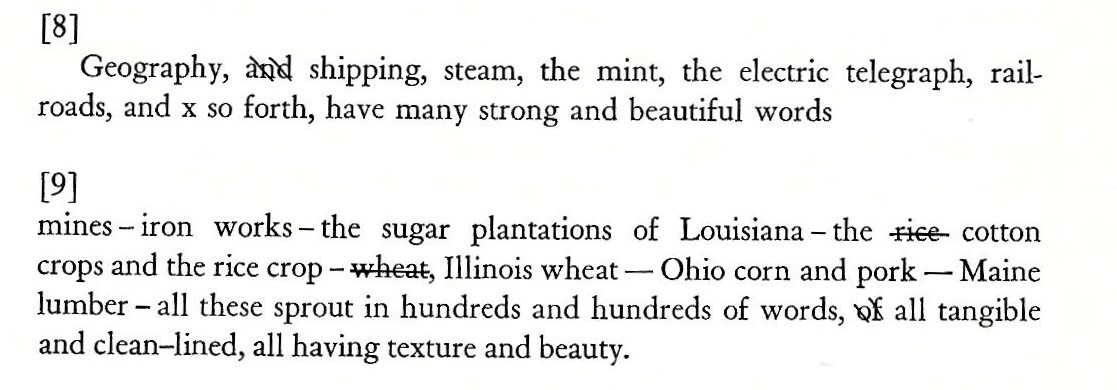
Walt Whitman: Daybooks and Notebooks, edited by William White, Volume III, pg. 733 (New York University Press, 1978)
Interlink’ d, food-yielding lands!
Land of coal and iron! land of gold! land of cotton, sugar, rice! Land of wheat, beef, pork! land of wool and hemp! land of the
apple and the grape!
Land of the pastoral plains, the grass-fields of the world! land of
those sweet-air’d interminable plateaus!
Land of the herd, the garden, the healthy house of adobie! Lands where the north-west Columbia winds, and where the
south-west Colorado winds!
Land of the eastern Chesapeake! land of the Delaware!
Land of Ontario, Erie, Huron, Michigan!
Land of the Old Thirteen! Massachusetts land! land of Vermont
and Connecticut!
Land of the ocean shores! land of sierras and peaks!
— from Walt Whitman, “Starting from Paumanok”
excerpt from ‘Starting from Paumanok’
*****************************************************
Walt Whitman’s catalogues. Long lists. A stylistic feature of his poetry.
– posted by Roger W. Smith
August 2020
from ‘There was a child went forth’
The streets themselves and the facades of houses, and goods in
the windows,
Vehicles, teams, the heavy-plank’d wharves, the huge crossing
at the ferries,
The village on the highland seen from afar at sunset, the river
between,
Shadows, aureola and mist, the light falling on roofs and gables
of white or brown two miles off,
The schooner near by sleepily dropping down the tide, the little
boat slack-tow’ d astern,
The hurrying tumbling waves, quick-broken crests, slapping,
The strata of color’d clouds, the long bar of maroon-tint away
solitary by itself, the spread of purity it lies motionless in,
The horizon’s edge, the flying sea- crow, the fragrance of salt
marsh and shore mud,
These became part of that child who went forth every day, and
who now goes, and will always go forth every day.
— from Walt Whitman, “There Was a Child Went Forth” (1855)
*****************************************************
As noted by James Perrin Warren in his monograph Walt Whitman’s Language Experiment, “This passage catalogues the scenes of New York and Brooklyn, scenes that will become central to later poems like ‘Crossing Brooklyn Ferry;’ ‘Out of the Cradle Endlessly Rocking;’ and ‘As I Ebb’d with the Ocean of Life.’ ”
The beautiful passage evokes images and thoughts of New York City which I can relate to.
— Roger W. Smith
August 2020
Walt Whtiman, from ‘Song of the Broad Axe’
His shape arises!
Arrogant, masculine, naive, rowdyish,
Laugher, weeper, worker, idler, citizen, country-man,
Saunterer of woods, stander upon hills, summer swimmer in
rivers or by the sea,
Of pure American breed, of reckless health, his body perfect,
free from taint from top to toe, free forever from headache
and dyspepsia, clean-breathed,
Ample-limbed, a good feeder, weight a hundred and eighty
pounds, full-blooded, six feet high, forty Inches round the
breast and back,
Countenance sun-burnt, bearded, calm, unrefined,
Reminder of animals, meeter of savage and gentleman on equal
terms,
Attitudes lithe and erect, costume free, neck open, of slow
movement on foot,
Passer of his right arm round the shoulders of his friends,
companion of the street,
Persuader always of people to give him their sweetest touches,
and never their meanest,
A Manhattanese bred, fond of Brooklyn, fond of Broadway, fond
of the life of the wharves and the great ferries,
Enterer everywhere, welcomed everywhere, easily understood
after all,
Never offering others, always offering himself, corroborating his
phrenology,
Voluptuous, inhabitive, combative, conscientious, alimentive,
intuitive, of copious friendship, sublimity, firmness, self-
esteem, comparison, individuality, form, locality, eventuality,
Avowing by life, manners, works, to contribute illustrations of
results of The States,
Teacher of the unquenchable creed, namely, egotism,
Inviter of others continually henceforth to try their strength
against his.
— Walt Whitman, “Song of the Broad-Axe” (1856 version)
*****************************************************
For a discussion of this passage — and of Whitman’s brilliant use of –er nouns, formed from adding suffixes to verbs — see James Perrin Warren, Walt Whitman’s Language Experiment (The Pennsylvania State University Press, 1990), pp. 56-57,
Note Whitman’s genius in creating his own “grammar” in which the repetition of these nouns functions to create what the Whitman scholar Gay Wilson Allen* (drawing upon the work of the Italian scholar Pasquale Jannaccone, in his La Poesìa di Walt Whitman e L’Evoluzione delle Forme Ritmìche) calls “grammatical and logical rime.”
*Gay Wilson Allen, Walt Whitman Handbook (Packard and Company, 1946), pg. 408
*****************************************************
My former therapist, Dr. Ralph Colp. Jr. said, exclaimed, to me once, that Walt Whitman was a wonderful, a marvelous, PERSON. How true. How much I would like to be able to say I partook of some of these personal qualities.
— Roger W. Smith
August 2020
This post is in the format of a 20-page essay (downloadable Word document above).
from the introduction:
I have become well acquainted with Walt Whitman’s Leaves of Grass through repeated readings — I have committed many lines to memory. From familiarity — and, I suppose one would say, the spiritual comfort Whitman’s poetry gives me — Leaves of Grass has become a sort of Bible for me.
Below is a compilation by me of striking, beautiful, brilliant — so original, and often unique — images that I have culled from Leaves of Grass. I think they prove that Whitman, who is deliberately and studiously non-literary — without affectation and without using common poetic tropes — constantly infuses his poetry with images of startling beauty. That’s the best way I know how to put it.
— posted by Roger W. Smith
June 2020

