At the cider-mill, tasting the sweets of the brown
mash, sucking the juice through a straw
— Walt Whitman, “Song of Myself”

William Sidney Mount, “Cider-Making”
–– posted by Roger W. Smith
June 2023
At the cider-mill, tasting the sweets of the brown
mash, sucking the juice through a straw
— Walt Whitman, “Song of Myself”
William Sidney Mount, “Cider-Making”
–– posted by Roger W. Smith
June 2023
Tyree, ‘Thoreau, Whitman, and the Matter of New York’
Posted here (PDF above):
J. M. Tyree, “Thoreau, Whitman, and the Matter of New York,” New England Review, Vol. 27, No. 1 (2006), pp. 61-75
— posted by Roger W. Smith
May 2023
‘Walt Whitman – With Glimpses of Chase and O’Connor’
Posted here (PDF above) is Chapter XII (“Walt Whitman—With Glimpses of [Salmon P.] Chase and [William D.] O’Connor”) from
John Townsend Trowbridge, My Own Story: Recollections of Noted Persons (Boston: Houghton, Mifflin and Company, 1903)
John Townsend Trowbridge (1827-1916) was an American author and novelist. He lived for most of his adult life in Arlington, Massachusetts. Trowbridge was a friend of Mark Twain and Walt Whitman.
Also posted here:
John T. Trowbridge obituary, Boston Globe, February 13, 1916
J. T. Trowbridge obituary, Chicago Tribune, February 13, 1916
“Trowbridge and Whitman,” Boston Globe, February 20, 1916
‘Trowbridge and Whitman’ – Boston Globe 2-20-1916
— posted by Roger W. Smith
May 2023
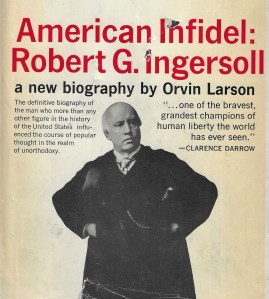
Robert G. Ingersoll, ‘Mark Twain and Walt Whitman’
Posted here (PDF above) :
“Mark Twain and Walt Whitman”
a chapter from Orvin Larson’s biography American Infidel: Robert G. Ingersoll (New York: The Citadel Press, 1962)
Robert Green Ingersoll (1833-1899) was an American lawyer, writer, and orator. Known as “the Great Agnostic,” he achieved prominence as a lecturer who questioned the tenets of orthodox religion,
— Roger W, Smith
May 2023
*****************************************************
See also:
Robert G. Ingersoll, “Address at the Funeral of Walt Whitman”
Robert G. Ingersoll, “Address at the Funeral of Walt Whitman”
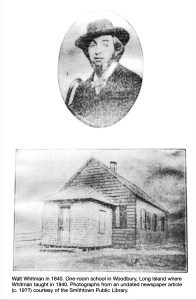
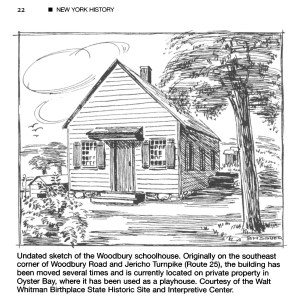
Walt Whitman taught at several country schools on Long Island in the 1830s and early 1840s.
Woodbury, where the school pictured above was located, is a hamlet located within the town of Oyster Bay in Nassau County, on Long Island. It is not far from West Hills, where Whitman was born.
Posed here are two articles about Whitman schoolteacher:
Horace L. Ttraubel, ‘Walt Whitman Schoolmaster’
Horace L. Traubel, “Walt Schoolmaster: Notes of a Conversation with Charles A. Roe, 1894”
Walt Whitman Fellowship Papers; an address delivered in Philadelphia in April 1895
Charles Roe was one of Whitman’s pupils at a school in what is now Queens (it was then part of Long Island).
Natalie A. Naylor, ‘Walter Whitman at School’ (2)
Natalie A. Naylor, “Walter Whitman at School: Education and Teaching in the Nineteenth Century”
New York History, Vol. 86, No. 1 (Winter 2005), pp. 6-27
— posted by Roger W. Smith
May 2023
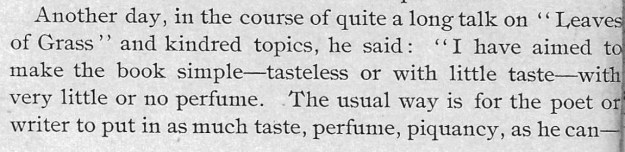
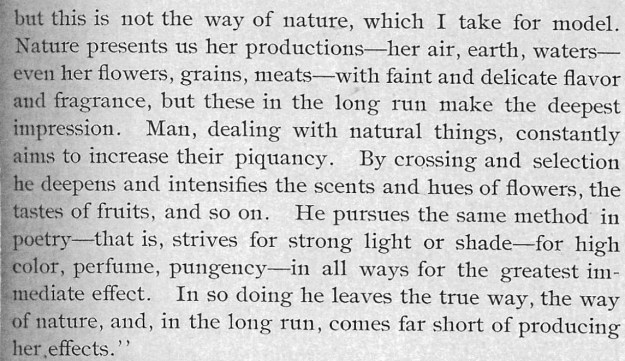
from
Richard Maurice Bucke, “Memories of Walt Whitman,” Walt Whitman Fellowship Papers 6 (September 1894), pp. 42-43
Bucke’s paper was read at meeting of the Walt Whitman Fellowship in Philadelphia on May 31, 1894.
— posted by Roger W. Smith
May 2023
Posted here (Word document above) are excerpts from the chapter on Whitman in in R. W. B. Lewis, Trials of the Word; Essays in American Literature and the Humanistic Tradition (New Haven: Yale University Press, 1965).
Lewis’s insights are brilliant and stimulating.
— posted by Roger W. Smith
May 2022

George J. Smith, ‘Whitman and Mannahatta’
Posted here:
George J. Smith
“Whitman and Mannahatta”
read at the annual meeting of the Walt Whitman Fellowship, New York, May 31, 1898
— posted by Roger W. Smith
May 2023
My post
has been updated with a brief summary of my own, as well as the addition of the chapter “Anti-Slavery Notes” [Whitman’s] from the the book Walt Whitman’s Workshop: A Collection of Unpublished Manuscripts, edited with an introduction and notes by Clifton Joseph Furness.
— Roger W. Smith
May 2, 2023
George M. Fredrickson, The Inner Civil War
Fredrickson, ‘The Inner Civil War’ (excepts)
Gay Wilson Allen, The Solitary Singer
Allen, ‘The Solitary Singer’ (excerpts)
Horace Traubel, With Walt Whitman in Camden
from Horace Traubel, ‘With Walt Whitman in Camden’
Furness, Walt Whitman’s: Workshop: A Collection of Unpublished Manuscripts
from ‘Walt Whitman’s workshop’
Whitman, “Anti-Slavery Notes”
CORRESPONDENCE (Walt Whitman)
Charles I. Glicksberg, “Walt Whitman and the Negro”
Glicksberg, ‘Walt Whitman and the Negro’
Martin G. Murray, “Traveling with the Wounded: Walt Whitman and Washington’s Civil War Hospitals”
Martin G. Murray, ‘Wbitman and Washington’s Civil War Hospitals’
Ted Genoways. “Whitman and the Civil War”
Ted Genoways, ‘Whitman and the Civil War’
SUMMARY
Whitman regarded the slavery issue as secondary. It was the preservation of the Union that mattered most. “Not the negro, not the negro,” Whitman told Horace Traubel. The negro was not the chief thing: the chief thing was to stick together.”
As Charles I. Glicksberg pointed out, Whitman in his poetry nowhere denounces the evils of racial intolerance and racial discrimination. Like Lincoln, he believed that blacks were unfit to be full participants in a democracy, that they were unfit for suffrage.
To Thomas P. Sawyer, Whitman wrote: “I believe this Union will conquer in the end. … This country can’t be broken up by Jeff Davis, & all his damned crew. … life would have no charm for me, if this country should fail after all, and be reduced to take a third rate position, to be domineered over by England & France & the haughty nations of Europe &c and we unable to help ourselves. But I have no thought that will ever be, this country I hope would spend her last drop of blood, and last dollar, rather than submit to such humiliation.”
It was a common belief (and fear) that if the North were defeated, the country would be weakened and in jeopardy as an actor on the world stage.
Shortly after the battle of Bull Run, Whitman wrote the poem “Beat! Beat! Drums!,” which concludes:
Beat! beat! drums!—blow! bugles! blow!
Make no parley—stop for no expostulation,
Mind not the timid—mind not the weeper or prayer,
Mind not the old man beseeching the young man,
Let not the child’s voice be heard, nor the mother’s entreaties,
Make even the trestles to shake the dead where they lie awaiting the hearses,
So strong you thump O terrible drums—so loud you bugles blow.
Whitman began visiting wounded soldiers in New York hospitals; and after his brother George was wounded, began to do the same in hospitals in Washington, DC, to which he moved. Sympathy for the sick and discouraged made it impossible for him to leave.
— posted by Roger W. Smith
April 2023

 Roger W. Smith's Walt Whitman site