See my post:
Walt Whitman to Anson Ryder, Jr.
— Roger W. Smith
March 2023
See my post:
Walt Whitman to Anson Ryder, Jr.
— Roger W. Smith
March 2023
Walt Whitman, ‘Abstract yourself from this book’ (prose fragment)
PDF above.
Abstract yourself from this book; realize where you are at present located, the point you stand that is now to you the centre of all. Look up overhead, think of space stretching out, think of all the unnumbered orbs wheeling safely there, invisible to us by day, some visible by night … . Spend some minutes faithfully in this exercise. Then again realize yourself upon the earth, at the particular point you now occupy … [thinks of four directions]. Seize these firmly in your mind, pass freely over immense distances. Turn your face a moment thither. Fix definitely the direction and the idea of the distances of separate sections of your own country, also of England, the Mediterranean sea, Cape Horn, the North Pole, and such like distant places.
— Walt Whitman, “? Outset of Lecture,” IN Notebooks and Unpublished Prose Manuscripts, Volume IV, edited by Edward F. Grier ( New York University Press , 1984)
This quote from Whitman’s notes to himself is, in my opinion, highly significant – in that it reveals the type of thinking and perspective that went into the writing of his great poems, notably the early ones.
— posted by Roger W. Smith
March 2023
review of ‘Rebel Souls; Walt Whitman and America’s First Bohemians’
posted here (Word document above) is a review of:
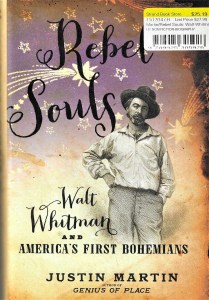
Justin Martin, Rebel Souls: Walt Whitman and America’s First Bohemians
reviewed by Stephanie M. Blalock
Walt Whitman Quarterly Review, Vol. 32, Issue 3 (winter 2015)
It is an excellent, informative review.
— posted by Roger W. Smith
March 2023
*****************************************************
See also my post
In flaunting his rudeness and scorn of all refinements, Whitman aroused the class-conscious fears of such genteel critics and literary historians as Barrett Wendell, professor of English at Harvard College and personal friend of the “Boston Brahmins.” In his Literary History of America published in 1901 he could not ignore Whitman, and he gave him equal space with Longfellow and Whittier. But his sympathies were with Lowell, who “lived all his life amid the gentlest academic and social influences of America,” and Whittier, who, though of humble origin, “lived almost all of his life amid guileless influences.” But Walt Whitman, “born of the artisan class in a region close to the most considerable and corrupt centre of population on his native continent,” held a “conception of equality utterly ignoring values,” which Wendell saw as a danger to the American nation. Wendell knew that society was changing, but the increasing political power of the recent immigrants crowding the “New York slums and dingy suburban country” portended a future he could only anticipate with horror: “Those of us who love the past are far from sharing his [Whitman’s] confidence in the future.” But Barrett Wendell was an honest man, and he had to confess that the “substance of Whitman’s poems,—their imagery as distinguished from their form, or their spirit—comes wholly from our native country …. He can make you feel for the moment how even the ferry-boats plying from New York to Brooklyn are fragments of God’s eternities.’ ‘
Gay Wilson Allen, A Reader’s Guide to Walt Whitman (Syracuse University Press, 1997)
*****************************************************
Posted here (below), excerpts from Barrett Wendell, A Literary History of America (New York: Charles Scribner’s Sons, 1901), pp. 462-479
— Roger W. Smith
March 2023
Introduction, ‘The Half-Breed and Other Stories’
I have obtained a rare book:
The Half-Breed and Other Stories by Walt Whitman
Collected and Edited by Thomas Ollive Mabbott
Columbia University Press, 1927
I have posted here the Introduction by the editor, Thomas Ollive Mabbott. The pages were difficult to copy due to the book’s tight binding.
The early stories by Whitman in this hook have been reprinted in Walt Whitman, The Early Poems and the Fiction, edited by Thomas L. Brasher (New York University Press, 1963).
— posted by Roger W. Smith
March 2023
This is what you shall do: Love the earth and sun and the animals, despise riches, give alms to every one that asks, stand up for the stupid and crazy, devote your income and labor to others, hate tyrants, argue not concerning God, have patience and indulgence toward the people, take off your hat to nothing known or unknown or to any man or number of men, go freely with powerful uneducated persons and with the young and with the mothers of families, read these leaves in the open air every season of every year of your life, re-examine all you have been told at school or church or in any book, dismiss whatever insults your own soul, and your very flesh shall be a great poem and have the richest fluency not only in words but in the silent lines of its lips and face and between the lashes of your eyes and in every motion and joint of your body.
Walt Whitman, Leaves of Grass, Preface to the first (1855) edition
— posted by Roger W. Smith
March 2023
This excellent chronology (PDF above) was published in Gay Wilson Allen, A Reader’s Guide to Walt Whitman.
— posted by Roger W. Smith
March 2023
A superb reader.
— -posted by Roger W. Smith
March 2023
Keller, ‘Walt Whitman on Mickle Street’
Posted here as a PDF document, a rare book of biographical interest:
Elizabeth Leavitt Keller, Walt Whitman in Mickle Street (New York: Mitchell Kennerley, 1921)
Mrs. Keller was Whitman’s nurse in his final years.
— posted by Roger W. Smith
February 2023
Posted here as PDF documents are excerpts from two rare books which I have purchased.
The authors both knew Walt Whitman.
*****************************************************
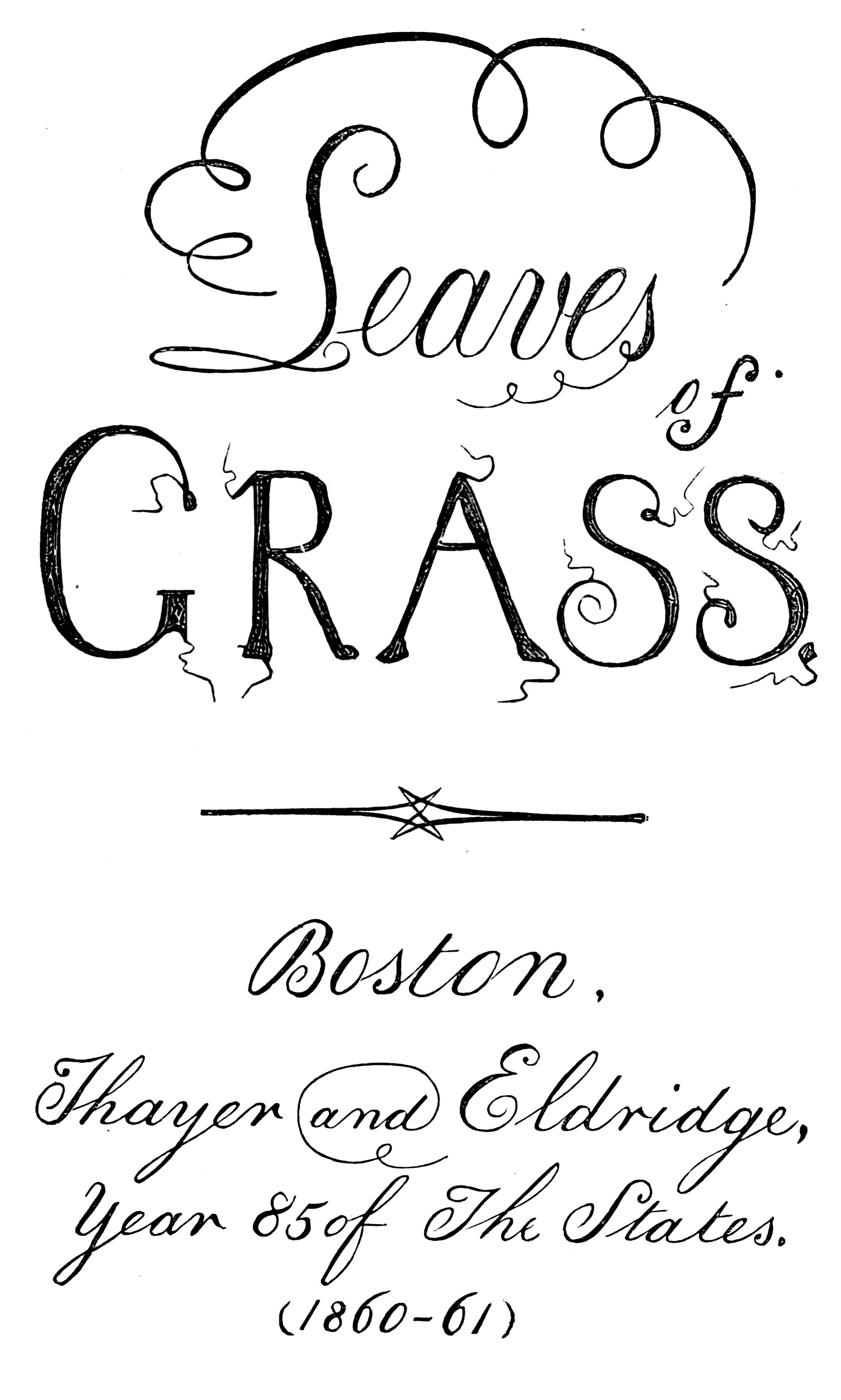
James Redpath, The Public Life of Capt. John Brown, with an Auto-Biography of His Childhood and Youth (Boston: Thayer and Eldridge, 1860)
James Redpath (1833–1891) was the author of The Public Life of Capt. John Brown, a correspondent for the New York Tribune during the war, the originator of the “Lyceum” lectures, and editor of the North America Review, beginning in 1886. He met Walt Whitman in Boston in 1860 and remained an enthusiastic admirer.
*****************************************************
One of the most beloved and tender hearted of the visitors at the hospitals in Washington, is Walt. Whitman, author of Leaves of Grass. However his “barbaric yawp” may sound over other roofs, it sends sweet music into the sick wards of the Capital. A gentleman who accompanied him on several of his visits, relates that his coming was greeted by the soldiers unvarying pleasure, and that he soothed the homesick boys so often seen there, with a tenderness that no woman could excel. His friends say that he cured one or two young soldiers who were dying of homesickness, by his sympathy and loving-kindness. Dying of homesickness is no figure of speech, but a reality of weekly occurrence in our army. To such invalids the religious tract, or the mechanical consolations of theology, give no relief; not musty manna from the church wilderness, but living waters of sympathy from the warm heart of man who loves them is what they need to save them. And this they get from the rough singer of Brooklyn. Walt. like other poets, is not excessively rich, and therefore may not stay in Washington much longer; but as long as he can afford to remain he means to keep at his self-elected and unpaid post, doing good to the sick and wounded. What a pity that when so many thousands of dollars are spent to but little purpose for this work that a hundred or two could not be devoted to retain this efficient volunteer.
— James Redpath, Commonwealth, April 10, 1863
*****************************************************
Richard J. Hinton, John Brown and His Men; with Some Account of the Roads They Traveled to Reach Harper’s Ferry (New York: Funk & Wagnalls Company, 1894)
Richard J. Hinton (1830–1901) was born in London and came to the US in 1851. He trained as a printer, and, like James Redpath, went to Kansas and joined John Brown’s militant group of abolitionists.
Hinton was the author of Hand-book to Kansas Territory and the Rocky Mountains’ Gold Region (1859). Later he wrote Rebel Invasion of Missouri and Kansas (1865) and John Brown and His Men (1894). Apparently, Hinton had suggested that Thayer & Eldridge print Leaves of Grass.
*****************************************************
Hinton served in the Union Army from 1861 to 1865, and saw Whitman while lying wounded in a hospital, a scene which he described in the Cincinnati Commercial on August 26, 1871:
When this old heathen [Walt Whitman] came and gave me a pipe and tobacco, it was “about the most joyous moment of my life …. There were plenty of [other visitors] I assure you. The little bay at the head of my cot was full of tracts and testaments, and every Sunday there were half a dozen old roosters who would come into my ward and preach and pray and sing to us, while we were swearing to ourselves all the time, and wishing the blamed fools would go away. Walt Whitman’s funny stories, and his pipes and tobacco were worth more than all the preachers and tracts in Christendom. A wounded soldier don’t like to be reminded of his God more than twenty times a day. Walt Whitman didn’t bring any tracts or Bibles; he didn’t ask if you loved the Lord, and didn’t seem to care whether you did or not.
— H.J. R. [Richard Hinton], “A Reminiscence,” Cincinnati Commercial, August 26, 1871.
*****************************************************
COMMENTARY
It is interesting to see in the prefaces to these two books how John Brown was regarded in the North at that time. Redpath’s book was published right after Brown’s execution.
There is evidence of Whitman’s relationships with Redpath and Hinton in his correspondence, and in the conversations that Whitman had with Horace Traubel.
*****************************************************
TWO POEMS
Walt Whitman, “Year of Meteors (1859-60)”
YEAR of meteors! brooding year!
I would bind in words retrospective, some of your deeds
and signs;
I would sing your contest for the 19th Presidentiad;
I would sing how an old man, tall, with white hair,
mounted the scaffold in Virginia;
(I was at hand—silent I stood, with teeth shut close—I
watch’d;
I stood very near you, old man, when cool and indifferent, but trembling with age and your unheal’d
wounds, you mounted the scaffold;)
I would sing in my copious song your census returns of
The States,
The tables of population and products—I would sing of
your ships and their cargoes,
The proud black ships of Manhattan, arriving, some
fill’d with immigrants, some from the isthmus
with cargoes of gold;
Songs thereof would I sing—to all that hitherward
comes would I welcome give;
And you would I sing, fair stripling! welcome to you
from me, sweet boy of England!
Remember you surging Manhattan’s crowds, as you
passed with your cortege of nobles?
There in the crowds stood I, and singled you out with
attachment;
I know not why, but I loved you…(and so go forth
little song,
Far over sea speed like an arrow, carrying my love all
folded,
And find in his palace the youth I love, and drop these
lines at his feet;)
—Nor forget I to sing of the wonder, the ship as she
swam up my bay,
Well-shaped and stately the Great Eastern swam up my
bay, she was 600 feet long,
Her moving swiftly, surrounded by myriads of small
craft, I forget not to sing;
Nor the comet that came unannounced, out of the north,
flaring in heaven,
Nor the strange huge meteor procession, dazzling and
clear, shooting over our heads,
(A moment, a moment long, it sail’d its balls of unearth-
ly light over our heads,
Then departed, dropt in the night, and was gone;)
—Of such, and fitful as they, I sing—with gleams from
them would I gleam and patch these chants;
Your chants, O year all mottled with evil and good!
year of forebodings! year of the youth I love!
Year of comets and meteors transient and strange!—lo!
even here, one equally transient and strange!
As I flit through you hastily, soon to fall and be gone,
what is this book,
What am I myself but one of your meteors?
Herman Melville, “The Portent”
Hanging from the beam,
Slowly swaying (such the law),
Gaunt the shadow on your green,
Shenandoah!
The cut is on the crown
(Lo, John Brown),
And the stabs shall heal no more.
Hidden in the cap
Is the anguish none can draw;
So your future veils its face,
Shenandoah!
But the streaming beard is shown
(Weird John Brown),
The meteor of the war.
— posted by Roger W. Smith
February 2023
 Roger W. Smith's Walt Whitman site