— posted by Roger W. Smith
May 2024
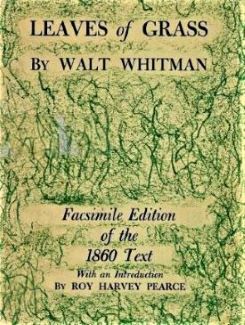
McClatchy, ‘An American Bard at 150’
“In these Leaves,” Whitman said, “every thing is literally photographed. Nothing is poeticized.”—J,D. McClatchy, The New York Sun
Posted here (World document above):
“An American Bard at 150”
By J.D. McClatchy
The New York Sun
April 1, 2005
J. D. McClatchy (1945-2018) was an American poet, opera librettist, and literary critic.
— posted by Roger W. Smith
July 2023
Posted here, in both the original Serbo-Croatian and in English translation — as separate documents — is the following:
Ivo Andrič
“Volt Vitmen (1819-1892)”
Knijževni jug (Zagreb) 4 (August 1, 1919): 49-55
With respect to the translation from Serbo-Croatian into English, I found one such translation on the internet (which may have been done with Google Translate) and made my own corrections and improvements.
Ivo Andrič (1892–1975) was a Yugoslavian novelist and poet. He won the Nobel Prize in Literature in 1961.
— posted by Roger W Smith
June 2023
Tyree, ‘Thoreau, Whitman, and the Matter of New York’
Posted here (PDF above):
J. M. Tyree, “Thoreau, Whitman, and the Matter of New York,” New England Review, Vol. 27, No. 1 (2006), pp. 61-75
— posted by Roger W. Smith
May 2023
In flaunting his rudeness and scorn of all refinements, Whitman aroused the class-conscious fears of such genteel critics and literary historians as Barrett Wendell, professor of English at Harvard College and personal friend of the “Boston Brahmins.” In his Literary History of America published in 1901 he could not ignore Whitman, and he gave him equal space with Longfellow and Whittier. But his sympathies were with Lowell, who “lived all his life amid the gentlest academic and social influences of America,” and Whittier, who, though of humble origin, “lived almost all of his life amid guileless influences.” But Walt Whitman, “born of the artisan class in a region close to the most considerable and corrupt centre of population on his native continent,” held a “conception of equality utterly ignoring values,” which Wendell saw as a danger to the American nation. Wendell knew that society was changing, but the increasing political power of the recent immigrants crowding the “New York slums and dingy suburban country” portended a future he could only anticipate with horror: “Those of us who love the past are far from sharing his [Whitman’s] confidence in the future.” But Barrett Wendell was an honest man, and he had to confess that the “substance of Whitman’s poems,—their imagery as distinguished from their form, or their spirit—comes wholly from our native country …. He can make you feel for the moment how even the ferry-boats plying from New York to Brooklyn are fragments of God’s eternities.’ ‘
Gay Wilson Allen, A Reader’s Guide to Walt Whitman (Syracuse University Press, 1997)
*****************************************************
Posted here (below), excerpts from Barrett Wendell, A Literary History of America (New York: Charles Scribner’s Sons, 1901), pp. 462-479
— Roger W. Smith
March 2023
On my Sorokin site, I have a new post: an early article that the sociologist and social philosopher Pitirim A. Sorokin wrote about Walt Whitman, which I have translated from the original Russian.
Posted at
— Roger W. Smith
Walt Whtiman, from ‘Song of the Broad Axe’
His shape arises!
Arrogant, masculine, naive, rowdyish,
Laugher, weeper, worker, idler, citizen, country-man,
Saunterer of woods, stander upon hills, summer swimmer in
rivers or by the sea,
Of pure American breed, of reckless health, his body perfect,
free from taint from top to toe, free forever from headache
and dyspepsia, clean-breathed,
Ample-limbed, a good feeder, weight a hundred and eighty
pounds, full-blooded, six feet high, forty Inches round the
breast and back,
Countenance sun-burnt, bearded, calm, unrefined,
Reminder of animals, meeter of savage and gentleman on equal
terms,
Attitudes lithe and erect, costume free, neck open, of slow
movement on foot,
Passer of his right arm round the shoulders of his friends,
companion of the street,
Persuader always of people to give him their sweetest touches,
and never their meanest,
A Manhattanese bred, fond of Brooklyn, fond of Broadway, fond
of the life of the wharves and the great ferries,
Enterer everywhere, welcomed everywhere, easily understood
after all,
Never offering others, always offering himself, corroborating his
phrenology,
Voluptuous, inhabitive, combative, conscientious, alimentive,
intuitive, of copious friendship, sublimity, firmness, self-
esteem, comparison, individuality, form, locality, eventuality,
Avowing by life, manners, works, to contribute illustrations of
results of The States,
Teacher of the unquenchable creed, namely, egotism,
Inviter of others continually henceforth to try their strength
against his.
— Walt Whitman, “Song of the Broad-Axe” (1856 version)
*****************************************************
For a discussion of this passage — and of Whitman’s brilliant use of –er nouns, formed from adding suffixes to verbs — see James Perrin Warren, Walt Whitman’s Language Experiment (The Pennsylvania State University Press, 1990), pp. 56-57,
Note Whitman’s genius in creating his own “grammar” in which the repetition of these nouns functions to create what the Whitman scholar Gay Wilson Allen* (drawing upon the work of the Italian scholar Pasquale Jannaccone, in his La Poesìa di Walt Whitman e L’Evoluzione delle Forme Ritmìche) calls “grammatical and logical rime.”
*Gay Wilson Allen, Walt Whitman Handbook (Packard and Company, 1946), pg. 408
*****************************************************
My former therapist, Dr. Ralph Colp. Jr. said, exclaimed, to me once, that Walt Whitman was a wonderful, a marvelous, PERSON. How true. How much I would like to be able to say I partook of some of these personal qualities.
— Roger W. Smith
August 2020
In the “Divinity School Address” [given at Harvard Divinity School in 1838, Ralph Waldo] Emerson at times made it sound as though his understanding of Christ had transformed that figure into a type of the artist, a man who … had seen “further” than others with more limited vision–An example is Emerson’s statement of how Christ recognized “that God incarnates himself in man, and evermore goes forth anew to take possession of his World.” … in his later essay “The Poet,” … [Emerson] lambasted contemporary theologians for thinking it “a pretty air-castle to talk of the spiritual meaning of a ship or a cloud, of a city or a contract.” Such men prefer, he noted sardonically, “to come again to the solid ground of historical evidence,” not realizing “the highest minds of the world have never ceased to explore the double meaning, or shall I say the quadruple or centuple or much more manifold meaning, of every sensuous fact.” If his friends were to be faulted for any religious shortcomings, then, it was because they … did not perceive the literal presence of the miraculous in nature’s commonplace facts.
One of Emerson’s most revealing paragraphs in this essay deals specifically with his sense of the poet as a universal Christ-figure. … In “The Poet” Emerson thought it important to suggest how much his contemporaries needed another redeemer, one whose grasp of language and symbol, as well as of divine truth, was comparable to Christ’s, or at least to others among the world’s great prophets. …
Throughout the essay Emerson elaborates the intended equation between Christ and the poet. Like Christ, who stood as ransom before his Father for the entire human race, so, too, the poet is “representative” and “stands among partial men for the complete man.” Further, like the Christ who freed mankind again to the possibility of entering heaven, so the poet is a liberator who “unlocks our chains and admits us to a new thought.” When men are exposed to the truths the poet expresses, they recognize how “the use of his symbols has a certain power of emancipation for all men.” And like the Savior who called all unto him as children, when the poet speaks men “seem to be touched by a wand which makes [them] dance and run about happily, like children.” “Poets,” Emerson brazenly declares, “are thus liberating gods.”
Indeed, throughout the essay Emerson intends to make his readers aware that he means no deception when he equates the work of the Sayer with a process of salvation, for the poet provides a feeling akin to what those of an earlier generation (and, indeed, what some evangelicals of Emerson’s own day) would have called a conversion experience. As he continues in this vein, Emerson sounds as though he were making a narration of the influence of saving grace upon his soul. “With what joy,” he exclaims, “I begin to read a poem which I confide in as an inspiration! And now my chains are to be broken; I shall mount above these clouds and opaque airs in which I live . . . and from the heaven of truth I shall see and comprehend my relations.” The “new birth” is complete, for at such moments, Emerson announces confidently, he becomes “reconcile[d]” to live, while all nature becomes “renovate[d].” “Life will no more be a noise” to him who has experienced the effects of the poet’s vision; and, as self-righteously as any of his seventeenth-century New England ancestors, Emerson claims that then is he able to “see men and women and know the signs by which they may be discerned fools and satans.” The rebirth of his soul is complete, for “this day [when the poet’s message is heard] shall be better than my birthday: then I became an animal; now I am invited into the science of the real.”
This remarkable reworking of the morphology of conversion into an aesthetic experience takes on more significance when the reader is aware of how closely the older forms of religious vocabulary have been melded with terms from the idealistic philosophy to which Emerson had been exposed: He details this dream-vision of transcendence with reference to an explicitly Coleridgean term. “This insight,” Emerson declares, “expresses itself by what is called Imagination” and is best understood not by reference to any religious terminology but as “a very high sort of seeing, which does not come by study, but by the intellect being where and what it sees . . . by sharing the path or circuit of things through forms … ” In the presence of the poet wielding his liberating symbols, man stands, Emerson mystically suggests, “before the secret of the world, there where Being passes into Appearance and Unity into Variety.”
But it is imperative that the poet also become the “Sayer or Namer” and openly declare what has been hidden from his contemporaries because of their imperfect nature and limited vision. “The world being thus put under the mind for verb and noun, the poet is he who can articulate it.” The secret of the universe, to paraphrase Robert Frost, literally sits in the middle of men, and the poet must do all in his power to make the secret apparent.
For through that better perception he stands one step nearer to things, and sees the flowing or metamorphosis; perceives that … within the form of every creature is a force impelling it to ascend into a higher form; and following with his eyes the life, uses the form which expresses that life, and so his speech flows with the flowings of nature.
For the poet the world becomes “a temple whose walls are covered with emblems, pictures and commandments of the Deity,” and it becomes his job to convey the meaning behind those emblems as evocatively as he can. … Emerson indeed believed that “Nothing walks, or creeps, or grows, or exists, which must not in tum arise and walk before him [the poet] as an exponent of his meaning.” Thus, the lessons from men like [the American Swedenborgian Sampson] Reed and {Guillaume] Oegger were assimilated, but along with the important corollary that man must not, like the self-centered mystic, “nail a symbol to one sense, which was a true sense for a moment, but soon becomes old and false.” The poet is he who knows that “all symbols are fluxional; all language is vehicular and transitive, and is good, as ferries and horses are, for conveyance, not as farms and houses are, for homestead.” When man reads the true poet’s works, Emerson believes, he finds himself on a version of Jacob’s ladder, the rungs of which are assembled from the world’s natural facts and by which he is to climb to view the world of spirit.
— Philip F. Gura, The Wisdom of Words: Language, Theology, and Literature in the American Renaissance
*****************************************************
I have been reading a fascinating and enlightening monograph: The Wisdom of Words: Language, Theology, and Literature in the American Renaissance by Philip F. Gura (Wesleyan University Press, 1981), from which the above passages are quoted.
Who is the poet whom Emerson foresaw and spoke of? Walt Whitman, as has often been noted.
— Roger W. Smith
July 2018
This poem made me think of my recently departed friend Bill Dalzell, and of our talks during his last months.
AFTER THE SUPPER AND TALK.
After the supper and talk—after the day is done,
As a friend from friends his final withdrawal prolonging,
Good-bye and Good-bye with emotional lips repeating,
(So hard for his hand to release those hands—no more will they
meet,
No more for communion of sorrow and joy, of old and young,
A far-stretching journey awaits him, to return no more,)
Shunning, postponing severance—seeking to ward off the last
word ever so little,
E’en at the exit-door turning—charges superfluous calling back—
e’en as he descends the steps,
Something to eke out a minute additional—shadows of nightfall
deepening,
Farewells, messages lessening—dimmer the forthgoer’s visage
and form,
Soon to be lost for aye in the darkness—loth, O so loth to depart!
— Walt Whitman, Leaves of Grass
*****************************************************
Having finalized the arrangement of Leaves of Grass, Whitman published a supplemental volume of prose and poetry with the autumnal title November Boughs. Many of its sixty-four lyrics and what Whitman labeled its “poemets” … were added as an “Annex” to the 1888 edition as “Sands at Seventy.” These verses reported his cheerful bearing as he faced physical deterioration—solemn-sweet announcements of his readiness for death, and cheerful expressions of farewell. … In the prose preface “A Backward Glance O’er Travel’d Roads” (1888), Whitman wrote: “In the free evening of my day I give you reader the foregoing garrulous talk, thoughts, reminiscences,” and suggested that, alive or dead, he would ever aspire to talk to the living reader. That sentiment is beautifully developed in the bittersweet vers de société masterpiece ”After the Supper and Talk.” Against the onrush of the ultimate night the poem shows the Whitman figure striving to the very end to preserve his voice—the same “garrulous talk” he had referred to in the introduction to “A Backward Glance”—the “talk” that embodies his life force and his spiritual selfhood. He feels that his words alone will perpetuate him in the mortal sphere. Standing at the “exit-door” of life but loath to leave for the unknown, he clings compulsively to the warmth of human hands, to the music of human voices, and to the sound of his own voice. Although he hopes that his poetic voice will endure into the future, he wishes to prolong his mortal vocal powers as long as he can. In order to achieve dramatic distance, and perhaps to cushion the shock of his impending death, the poet employs a rhetorical device that is rarely found in his poems. He refers to himself in the third person and pictures himself observing from a distance the vanishing figure of the mortal Whitman. His reluctance to depart from the House of Life is expressed in a series of death-related metaphors. And as a master of participials, Whitman constructs a verse that (except for three lines contained within parentheses) forms an uncompleted statement, so that his departure, as he might have wished, seems to be postponed indefinitely.
— Harold Aspiz, So Long! Walt Whitman’s Poetry of Death
— posted by Roger W. Smith
March 2018
 Roger W. Smith's Walt Whitman site