Author Archives: Roger W. Smith

Unknown's avatar

About Roger W. Smith

Roger W. Smith is a writer and independent scholar based in New York City. His experience includes freelance writing and editing, business writing, book reviewing, and the teaching of writing and literature as an adjunct professor at St. John’s University. Mr. Smith's interests include personal essays and opinion pieces; American and world literature; culture, especially books and reading; classical music; current issues that involve social, moral, and philosophical views; and experiences of daily living from a ground level perspective. Sites on WordPress hosted by Mr. Smith include: (1) rogersgleanings.com (a personal site comprised of essays on a wide range of topics) ; (2) rogers-rhetoric.com (covering principles and practices of writing); (3) roger-w-smiths-dreiser.site (devoted to the author Theodore Dreiser); and (4) pitirimsorokin.com (devoted to sociologist and social philosopher Pitirim A. Sorokin).

Walt Whitman … profoundly a New Yorker


In his sprawl, his vaunting ambition, and his humanity, Walt Whitman was profoundly a New Yorker. His poetry bore no little resemblance to the “mettlesome, mad, extravagant city” that he called home, and to the end of his life, he remained “a Manhattanese, free, friendly and proud.”

Whitman was born in the small community of West Hills in Suffolk County, and he returned often to the rural scenes of “fish-shape Paumanok,” as he called Long Island. But he grew up in Brooklyn, at a time when it was growing explosively, and proudly called himself a “Brooklyn boy.” Like his father, he found occasional work in carpentry and contracting, and that may have affected the way he thought about his poetry–with “the preparatory jointing, squaring, sawing, mortising, the hoist-up of beams the push of them in their places, laying them regular.”

New York’s expansion resembled Whitman’s own during the “seed-time years” that preceded Leaves of Grass. He later claimed that the poems “arose out of my life in Brooklyn and New York from 1838 to 1853, absorbing a million people, for fifteen years, with an intimacy, an eagerness, and an abandon, probably never equaled.” Although he moved to Washington during the Civil War and then to Camden, New Jersey, he never stopped revisiting the New York of his imagination. In a letter from 1868, he wrote, “I sometimes think I am the particular man who enjoys the shows of all these things in New York more than any other mortal–as if it was all got up just for me to observe and study.” [italics added]

– exhibit label, “Walt Whitman: Bard of Democracy”; exhibition at the Morgan Library, New York, NY


*****************************************************

CITY OF SHIPS.

CITY of ships!
(O the black ships! O the fierce ships!
O the beautiful sharp-bow’d steam-ships and sail-ships!)
City of the world! (for all races are here,
All the lands of the earth make contributions here;)
City of the sea! city of hurried and glittering tides!
City whose gleeful tides continually rush or recede, whirling in and out with eddies and foam!
City of wharves and stores—city of tall façades of marble and iron!
Proud and passionate city—mettlesome, mad, extravagant city!
Spring up O city—not for peace alone, but be indeed yourself, warlike!
Fear not—submit to no models but your own O city!
Behold me—incarnate me as I have incarnated you!
I have rejected nothing you offer’d me—whom you adopted I have adopted,
Good or bad I never question you— love all—I do not condemn any thing,
I chant and celebrate all that is yours—yet peace no more,
In peace I chanted peace, but now the drum of war is mine,
War, red war is my song through your streets, O city!

Leaves of Grass (1881-1882)


*****************************************************

But I was a Manhattanese, free, friendly, and proud
I was called by my nighest name by clear loud voices
of young men as they saw me approaching or passing,
Felt their arms on my neck as I stood, or the negligent leaning of their flesh against me as I sat,
Saw many I loved in the street, or ferry-boat, or public assembly, yet never told them a word,
Lived the same life with the rest, the same old laughing, gnawing, sleeping,
Played the part that still looks back on the actor or actress,
The same old rôle, the rôle that is what we make it, as great as we like,
Or as small as we like, or both great and small.

— Walt Whitman, “Crossing Brooklyn Ferry” (excerpt)\


*****************************************************

The house-builder at work in cities or anywhere,
The preparatory jointing, squaring, sawing, mortising,
The hoist-up of beams, the push of them in their places,
laying them regular

— Walt Whitman, “Song of the Broad-Axe” (excerpt)


*****************************************************

The exhibit label is vague about where Whitman actually lived during his years in what now comprises New York City. (Brooklyn and Manhattan were separate municipalities when Whitman lived there. Jamaica, Queens, where Whitman was a schoolteacher briefly, was then part of Long Island, where Whitman was born.) He grew up in Brooklyn; and, in the years of his adulthood prior to the Civil War, he resided in both Brooklyn and Manhattan at various times. When in Manhattan, he lived downtown in boarding houses in or near what is now the Financial District. When he was residing in Brooklyn, he often took the ferry to Manhattan. He was a regular at Pfaff’s beer cellar in Manhattan, which was located on Broadway near Bleecker Street.

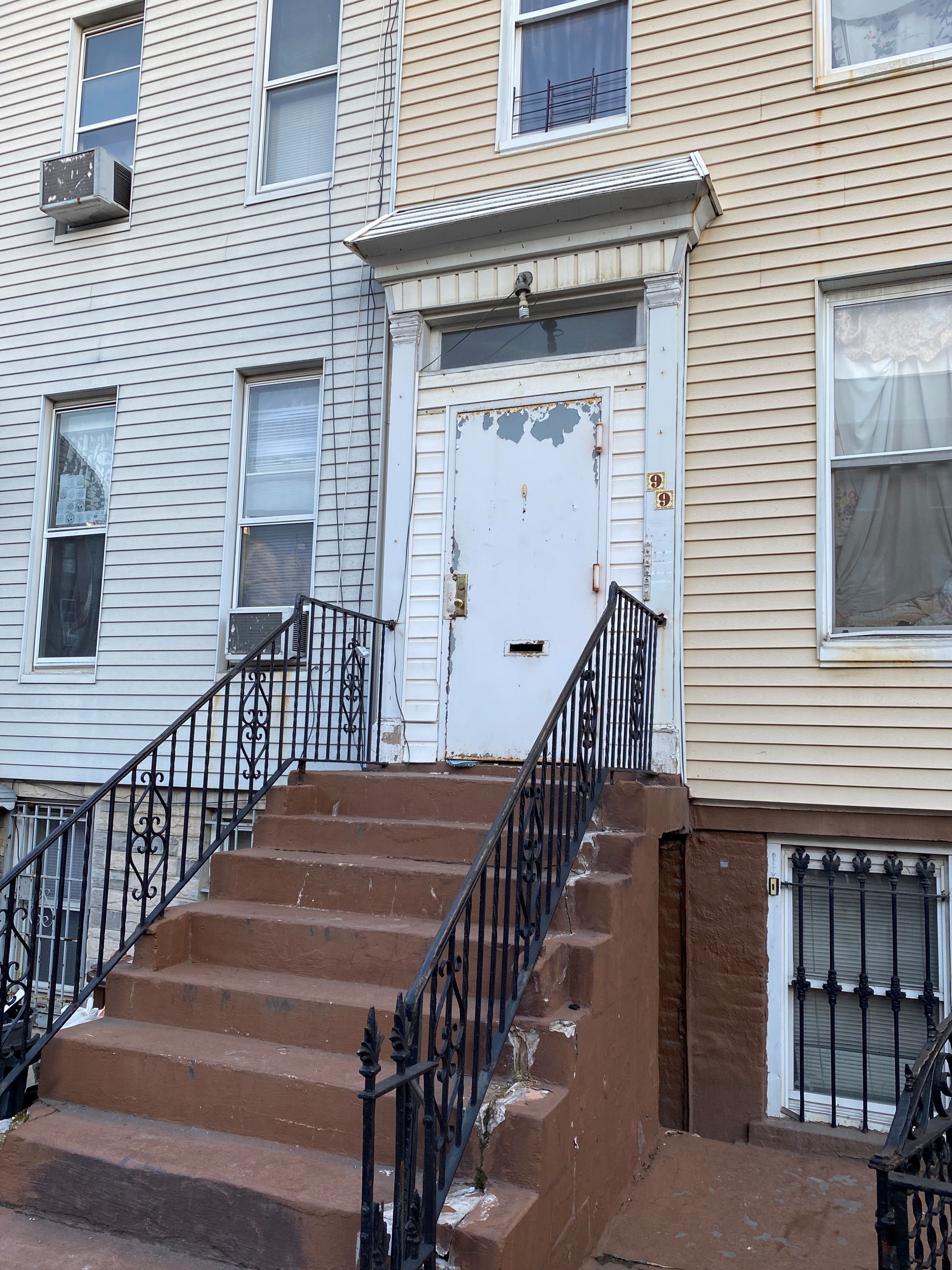
Whitman lived on Ryerson Street in Brooklyn in the 1850s.


*****************************************************

photos by Roger W. Smith

former Whitman home, 99 Ryerson Street, Brooklyn (Clinton Hill Section)

99 Ryerson Street

*****************************************************

See:

“Should Walt Whitman’s House Be Landmarked? It’s Complicated: The city does not think so, and the building’s owner agrees. Then there’s the matter of whether the poet should be honored in such a diverse neighborhood.,” By Jane Margolies,  The New York Times, December 24, 2019

‘Should Walt Whitman House Be Landmarked’ – NY Times 12-24-2019


— posted by Roger W. Smith


*****************************************************

Addendum:

In 2017, University of Iowa Press published a lost Whitman novel (its existence was unknown to scholars):  Life and Adventures of Jack Engle, which was originally published by Whitman in 1852 under a pseudonym and was serialized in a New York newspaper, the Sunday Dispatch. Zachary Turpin, who wrote an introduction to the 2017 edition, made this remarkable discovery.

If one reads the novel, which is set in Manhattan at around the time of Whitman’s boyhood — i.e., the early nineteenth century —  one can readily perceive Whitman’s familiarity with the City, which provides a setting and backdrop for the events and gives the story verisimilitude.

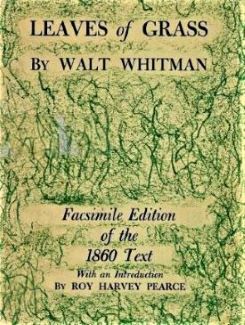
how could she omit the dates? (Whitman scholars won’t be happy)


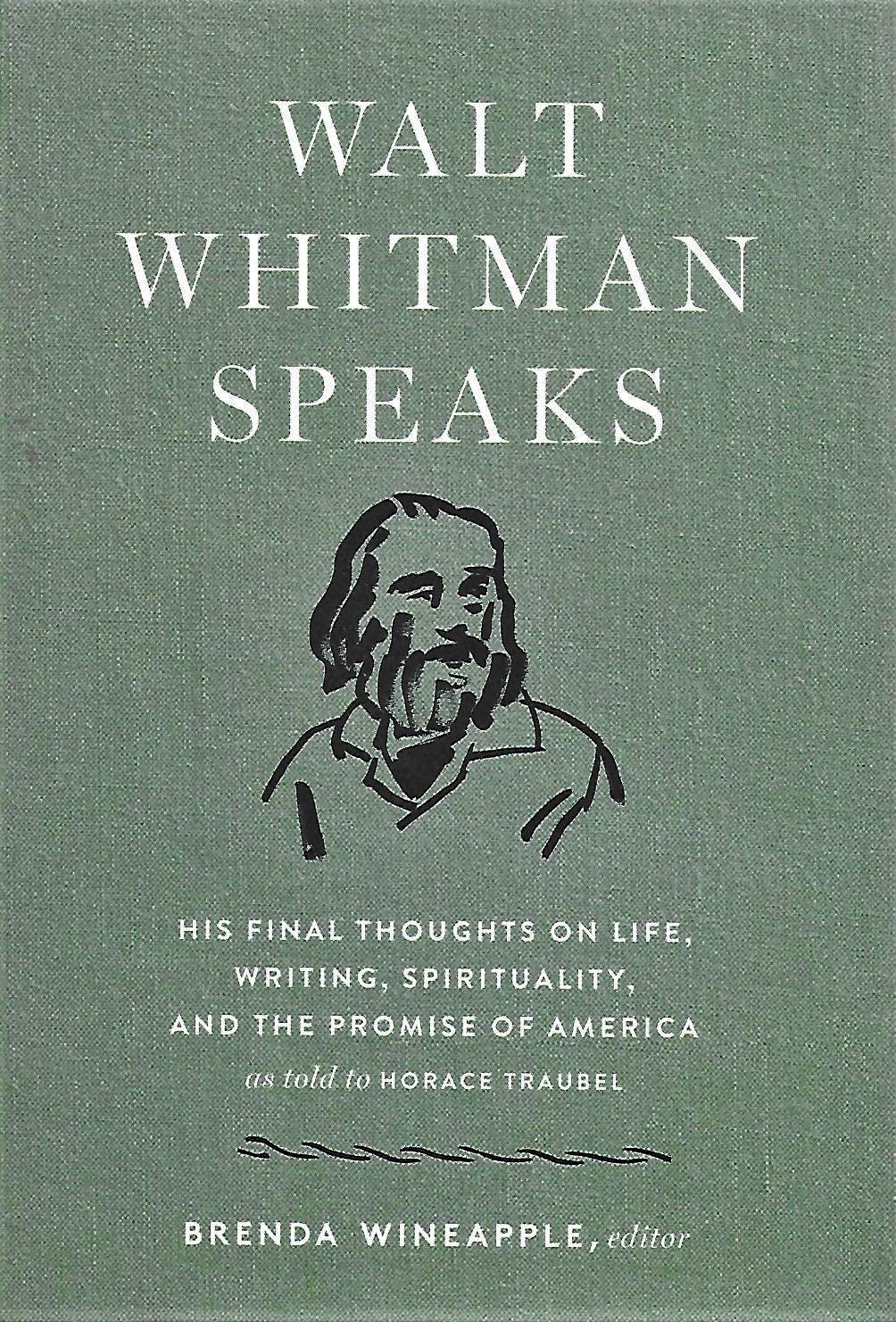
'Walt Whitman Speaks' -book cover


I purchased yesterday at the Stand Bookstore the following slim book:

Walt Whitman Speaks: His Final Thoughts on Life, Writing, Spirituality, and the Promise of America

as told to Horace Traubel

edited and with an introduction by Brenda Wineapple

New York: Library of America, 2019

Whitman’s remarks are grouped, arranged, by topic.

They are all taken from With Walt Whitman in Camden by Whitman’s friend and acolyte Horace Traubel. Nowhere in the present volume is there any indication of on what DATE the conversation with Traubel occurred (all of which is fully indicted in the nine volumes of Traubel’s).

In James Boswell’s Life of Johnson, the date on which a conversation with Johnson occurred is an important consideration, and was duly noted by Boswell. Same thing here (regarding the importance of dating when the remark was made).

What was Brenda Wineapple thinking? She is an accomplished and well known American literary scholar. I blame her, and also the Library of America.

Whitman scholars will be disappointed.


— Roger W. Smith

    May 2019

Walt Whitman: simplicity and complexity


“No one makes craft, carefully wrought, seem more casual than Walt Whitman.”

— Richard Rhodes, How to Write: Advice and Reflections (New York: William Morrow and Company, 1995), pg. 12


A former friend of mine, the poet Charles Pierre, made a comment to me — I wish I could remember exactly what he said — to the effect that Walt Whitman is actually very difficult. Difficult for the reader, that is. That he presents a level of difficulty that requires acute understanding of? I think Pierre would have said: an understanding of what Whitman is doing; of his poetic technique, of his originality, poetic genius, and ingenuity. That Whitman, who seems on the surface so simple, is not really simple.

And yet, I find Whitman to be easy to become acquainted with and comprehend without necessarily being (as in the case of myself) expert at poetry. I “got” his poetry almost right away.

— Roger W. Smith

   February 2019

New Yorkers


I was on a bus in Brooklyn a couple of weeks ago.

My eyes strayed to a seat across from me, and I saw that a young woman was smiling at me.

Beaming.

She had a five or six or year old boy in her lap. It was a bit different than holding a toddler in one’s lap. The boy was restless. But the mother and her son and seemed to be totally in sync.

“Is he going to school. Or he is too young for that?” I asked.

“No, he’s going to school,” she said, still smiling.

Then, I got off the bus. She waved at me and wished me a good day. It was as if we had been glad to meet.

This little encounter — unanticipated, most would say totally inconsequential — set me up for the rest of the day. It was as if somehow I had made her morning pleasurable. She certainly did that for me.

A reason I am writing about this is because this sort of thing happens to me very often in New York. I doubt such encounters would be as likely in the suburbs. (Certainly not if one were driving to work or an appointment.) Rubbing shoulders with others as a matter of course is something I love about living in NYC.

When I first moved to New York as a young man, everyone seemed to in a hurry, and the City seemed cold and impersonal.

It’s exactly the opposite. Many New Yorkers have told me that their experience has been the same.


*****************************************************

In his poem “Mannahatta,” Walt Whitman said something very similar:

Rich, hemm’d thick all around with sailships and
steamships, an island sixteen miles long, solid-founded,
Numberless crowded streets, high growths of iron, slender,
strong, light, splendidly uprising toward clear skies, …
The mechanics of the city, the masters, well-form’d,
beautiful-faced, looking you straight in the eyes,
Trottoirs throng’d, vehicles, Broadway, the women, the
shops and shows,
A million people–manners free and superb–open voices–
hospitality–the most courageous and friendly young
men,


— Roger W. Smith

   December 2018

“I knew a man”


I knew a man . . . . he was a common farmer . . . . he was the father of five sons . . .
and in them were the fathers of sons . . . and in them were the fathers of sons.

This man was of wonderful vigor and calmness and beauty of person;
The shape of his head, the richness and breadth of his manners, the pale yellow
and white of his hair and beard, the immeasurable meaning of his black eyes,
These I used to go and visit him to see . . . . He was wise also,
He was six feet tall . . . . he was over eighty years old . . . . his sons were massive
clean bearded tanfaced and handsome,

They and his daughters loved him . . . all who saw him loved him . . . they did not
love him by allowance . . . they loved him with personal love;
He drank water only . . . . the blood showed like scarlet through the clear brown
skin of his face;
He was a frequent gunner and fisher . . . he sailed his boat himself . . . he had a fine
one presented to him by a shipjoiner . . . . he had fowling-pieces, presented to
him by men that loved him;
When he went with his five sons and many grandsons to hunt or fish you would pick
him out as the most beautiful and vigorous of the gang,
You would wish long and long to be with him . . . . you would wish to sit by him in
the boat that you and he might touch each other.


*****************************************************

Written in free verse, “I knew a man,” by Walt Whitman, is part of “I SING THE BODY ELECTRIC.,” a poem with nine short subsections included in the original (1855) edition of Leaves of Grass.

It is a great example of the utter simplicity and non-literary character of Whitman’s poetry. (This aspect of Whitman’s poetry is analyzed and explained definitively in C. Carroll Hollis’s monograph Language and Style in Leaves of Grass [Louisiana State University Press, 1983]).

The poem is read here by the actor Ed Begley (1901-1970). Begley is, without question, the greatest reader, the greatest vocal interpreter, of Whitman’s poetry ever.


*****************************************************

Reflecting upon this poem, it occurs to me that I know, and have known (beginning with my parents), people eliciting such thoughts, such admiration from me.

People seemingly ordinary. Meaning not famous, or great as we commonly take great to mean when we speak of a great statesman, a great author, or any other person of such stature.

Ordinary people.

Yet remarkable people.

Men and women whose character, integrity, sincerity, kindness, thoughtfulness, unselfishness, fortitude, and so forth one is struck by over and over, almost daily. Of whom one finds oneself reminding oneself constantly what a privilege it is to know such persons. And of what they have to offer. To you or me.

Whitman stopped to admire a blade of grass. I often find myself, as did Whitman in this poem, “stopping to admire” ordinary people whom I meet and reflecting upon their wonderful qualities and, by extension, upon our common humanity.


— Roger W. Smith

   December 2018

an early take by Walt Whitman on his conception of himself as America’s poet


Walt Whitman began his writing career as a journalist. He was known early on for writing anonymous reviews of Leaves of Grass — in other words, reviewing himself, in laudatory terms. A motivation for his doing this was that he clearly felt his poetic endeavor would not be understood by the literati or his countrymen, and indeed his poetry initially baffled most and offended many because of its frankness, or what one might call lack of reticence when it came to topics not discussed in polite society. Even his own family seems not to have for the most part read his poetry or understood it.

Below is an unpublished puff piece by Whitman that was in his papers. It is not un-similar to anonymous reviews of Leaves of Grass he actually wrote. His conception of himself as a sort of literary gatecrasher is amusing. It has more than a grain of truth.


— Roger W. Smith

   August 2018


*****************************************************

We suppose it will excite the mirth of many of our readers to be told that a man has arisen, who has deliberately and insultingly ignored all the other, the cultivated classes as they are called, and set himself to write “America’s first distinctive Poem,” on the platform of these same New York Roughs, firemen, the ouvrier class, masons and carpenters, stagedrivers, the Dry Dock boys, and so forth; and that furthermore, he either is not aware of the existence of the polite social models, and the imported literary laws, or else he don’t value them two cents for his purposes.

Notes and Fragments, edited by R. M. Bucke; in Complete Writings of Walt Whitman, vol. IX (New York, 1902), pg. 70

“The Poet”


In the “Divinity School Address” [given at Harvard Divinity School in 1838, Ralph Waldo] Emerson at times made it sound as though his understanding of Christ had transformed that figure into a type of the artist, a man who … had seen “further” than others with more limited vision–An example is Emerson’s statement of how Christ recognized “that God incarnates himself in man, and evermore goes forth anew to take possession of his World.” … in his later essay “The Poet,” … [Emerson] lambasted contemporary theologians for thinking it “a pretty air-castle to talk of the spiritual meaning of a ship or a cloud, of a city or a contract.” Such men prefer, he noted sardonically, “to come again to the solid ground of historical evidence,” not realizing “the highest minds of the world have never ceased to explore the double meaning, or shall I say the quadruple or centuple or much more manifold meaning, of every sensuous fact.” If his friends were to be faulted for any religious shortcomings, then, it was because they … did not perceive the literal presence of the miraculous in nature’s commonplace facts.

One of Emerson’s most revealing paragraphs in this essay deals specifically with his sense of the poet as a universal Christ-figure. … In “The Poet” Emerson thought it important to suggest how much his contemporaries needed another redeemer, one whose grasp of language and symbol, as well as of divine truth, was comparable to Christ’s, or at least to others among the world’s great prophets. …

Throughout the essay Emerson elaborates the intended equation between Christ and the poet. Like Christ, who stood as ransom before his Father for the entire human race, so, too, the poet is “representative” and “stands among partial men for the complete man.” Further, like the Christ who freed mankind again to the possibility of entering heaven, so the poet is a liberator who “unlocks our chains and admits us to a new thought.” When men are exposed to the truths the poet expresses, they recognize how “the use of his symbols has a certain power of emancipation for all men.” And like the Savior who called all unto him as children, when the poet speaks men “seem to be touched by a wand which makes [them] dance and run about happily, like children.” “Poets,” Emerson brazenly declares, “are thus liberating gods.”

Indeed, throughout the essay Emerson intends to make his readers aware that he means no deception when he equates the work of the Sayer with a process of salvation, for the poet provides a feeling akin to what those of an earlier generation (and, indeed, what some evangelicals of Emerson’s own day) would have called a conversion experience. As he continues in this vein, Emerson sounds as though he were making a narration of the influence of saving grace upon his soul. “With what joy,” he exclaims, “I begin to read a poem which I confide in as an inspiration! And now my chains are to be broken; I shall mount above these clouds and opaque airs in which I live . . . and from the heaven of truth I shall see and comprehend my relations.” The “new birth” is complete, for at such moments, Emerson announces confidently, he becomes “reconcile[d]” to live, while all nature becomes “renovate[d].” “Life will no more be a noise” to him who has experienced the effects of the poet’s vision; and, as self-righteously as any of his seventeenth-century New England ancestors, Emerson claims that then is he able to “see men and women and know the signs by which they may be discerned fools and satans.” The rebirth of his soul is complete, for “this day [when the poet’s message is heard] shall be better than my birthday: then I became an animal; now I am invited into the science of the real.”

This remarkable reworking of the morphology of conversion into an aesthetic experience takes on more significance when the reader is aware of how closely the older forms of religious vocabulary have been melded with terms from the idealistic philosophy to which Emerson had been exposed: He details this dream-vision of transcendence with reference to an explicitly Coleridgean term. “This insight,” Emerson declares, “expresses itself by what is called Imagination” and is best understood not by reference to any religious terminology but as “a very high sort of seeing, which does not come by study, but by the intellect being where and what it sees . . . by sharing the path or circuit of things through forms … ” In the presence of the poet wielding his liberating symbols, man stands, Emerson mystically suggests, “before the secret of the world, there where Being passes into Appearance and Unity into Variety.”

But it is imperative that the poet also become the “Sayer or Namer” and openly declare what has been hidden from his contemporaries because of their imperfect nature and limited vision. “The world being thus put under the mind for verb and noun, the poet is he who can articulate it.” The secret of the universe, to paraphrase Robert Frost, literally sits in the middle of men, and the poet must do all in his power to make the secret apparent.

For through that better perception he stands one step nearer to things, and sees the flowing or metamorphosis; perceives that … within the form of every creature is a force impelling it to ascend into a higher form; and following with his eyes the life, uses the form which expresses that life, and so his speech flows with the flowings of nature.

For the poet the world becomes “a temple whose walls are covered with emblems, pictures and commandments of the Deity,” and it becomes his job to convey the meaning behind those emblems as evocatively as he can. … Emerson indeed believed that “Nothing walks, or creeps, or grows, or exists, which must not in tum arise and walk before him [the poet] as an exponent of his meaning.” Thus, the lessons from men like [the American Swedenborgian Sampson] Reed and {Guillaume] Oegger were assimilated, but along with the important corollary that man must not, like the self-centered mystic, “nail a symbol to one sense, which was a true sense for a moment, but soon becomes old and false.” The poet is he who knows that “all symbols are fluxional; all language is vehicular and transitive, and is good, as ferries and horses are, for conveyance, not as farms and houses are, for homestead.” When man reads the true poet’s works, Emerson believes, he finds himself on a version of Jacob’s ladder, the rungs of which are assembled from the world’s natural facts and by which he is to climb to view the world of spirit.

— Philip F. Gura, The Wisdom of Words: Language, Theology, and Literature in the American Renaissance


*****************************************************

I have been reading a fascinating and enlightening monograph: The Wisdom of Words: Language, Theology, and Literature in the American Renaissance by Philip F. Gura (Wesleyan University Press, 1981), from which the above passages are quoted.

Who is the poet whom Emerson foresaw and spoke of? Walt Whitman, as has often been noted.


— Roger W. Smith

   July 2018

house-building


The house-builder at work in cities or anywhere,
The preparatory jointing, squaring, sawing, mortising,
The hoist-up of beams, the push of them in their places, laying them regular,
Setting the studs by their tenons in the mortises according as they were prepared,
The blows of mallets and hammers, the attitudes of the men, their curv’d limbs,
Bending, standing, astride the beams, driving in pins, holding on by posts and braces,
The hook’d arm over the plate, the other arm wielding the axe,
The floor-men forcing the planks close to be nail’d,
Their postures bringing their weapons downward on the bearers,
The echoes resounding through the vacant building;
The huge storehouse carried up in the city well under way,
The six framing-men, two in the middle and two at each end,
carefully bearing on their shoulders a heavy stick for a
cross-beam,
The crowded line of masons with trowels in their right hands
rapidly laying the long side-wall, two hundred feet from front to rear,
The flexible rise and fall of backs, the continual click of the trowels striking the bricks,
The bricks one after another each laid so workmanlike in its place, and set with a knock of the trowel-handle,
The piles of materials, the mortar on the mortar-boards, and the steady replenishing by the hod-men;

— Walt Whitman, “Song of the Broad-Axe”


*****************************************************

As I told my students when I was teaching at St. John’s University, Walt Whitman the poet used the simplest words, images, and tropes he could find. He built his poems out of all-original materials that were, so to speak, close at hand (sort of like a bird using twigs on the ground to build a nest) — nothing was “literary” or derived.

Here we see minute observation.

The particular made universal. The concrete, the here and now, timeless.

Wonderful.

Whitman had a genius for using so called deverbal nouns, as is explained by James Perrin Warren in a fascinating book I have been reading: Walt Whitman’s Language Experiment (The Pennsylvania State University Press, 1990).


*****************************************************

Walt Whitman’s father, Walter Whitman, was a carpenter and house builder. Whitman was living in Brooklyn when Leaves of Grass was first published. His father was making a living then as a house builder. It was there that Ralph Waldo Emerson called in the year 1855 upon the poet, who in the frontispiece to the first edition of Leaves of Grass was pictured as a common working man, a Christlike carpenter-poet.


— Roger W. Smith

   July 2018

“What is the grass?”


1 Finland.jpg

countryside near Helsinki, Finland; photograph by Elisabeth van der Meer

11-53 IMG_0927 (2)

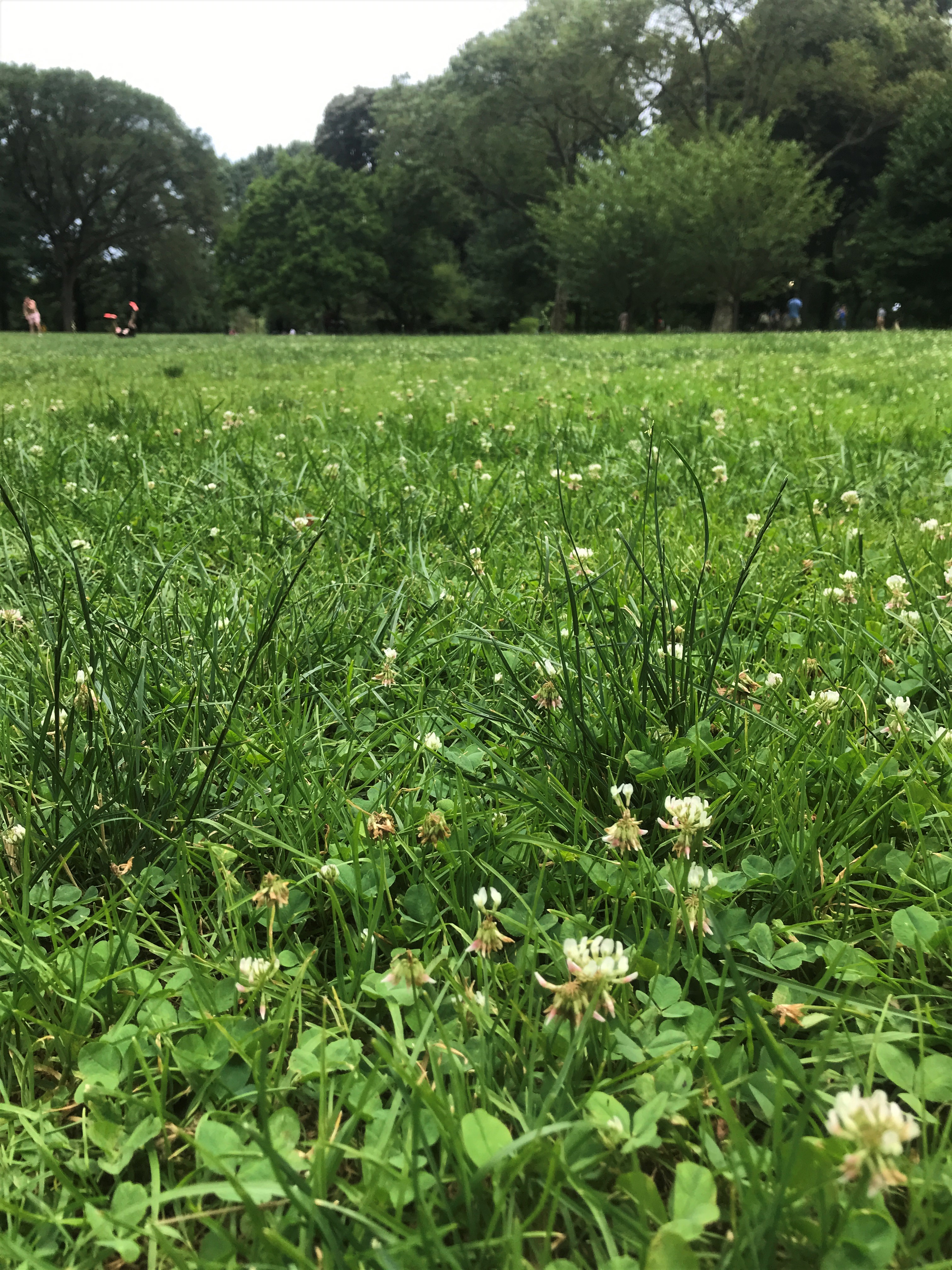
East Green, Central Park, New York; photograph by Roger W. Smith


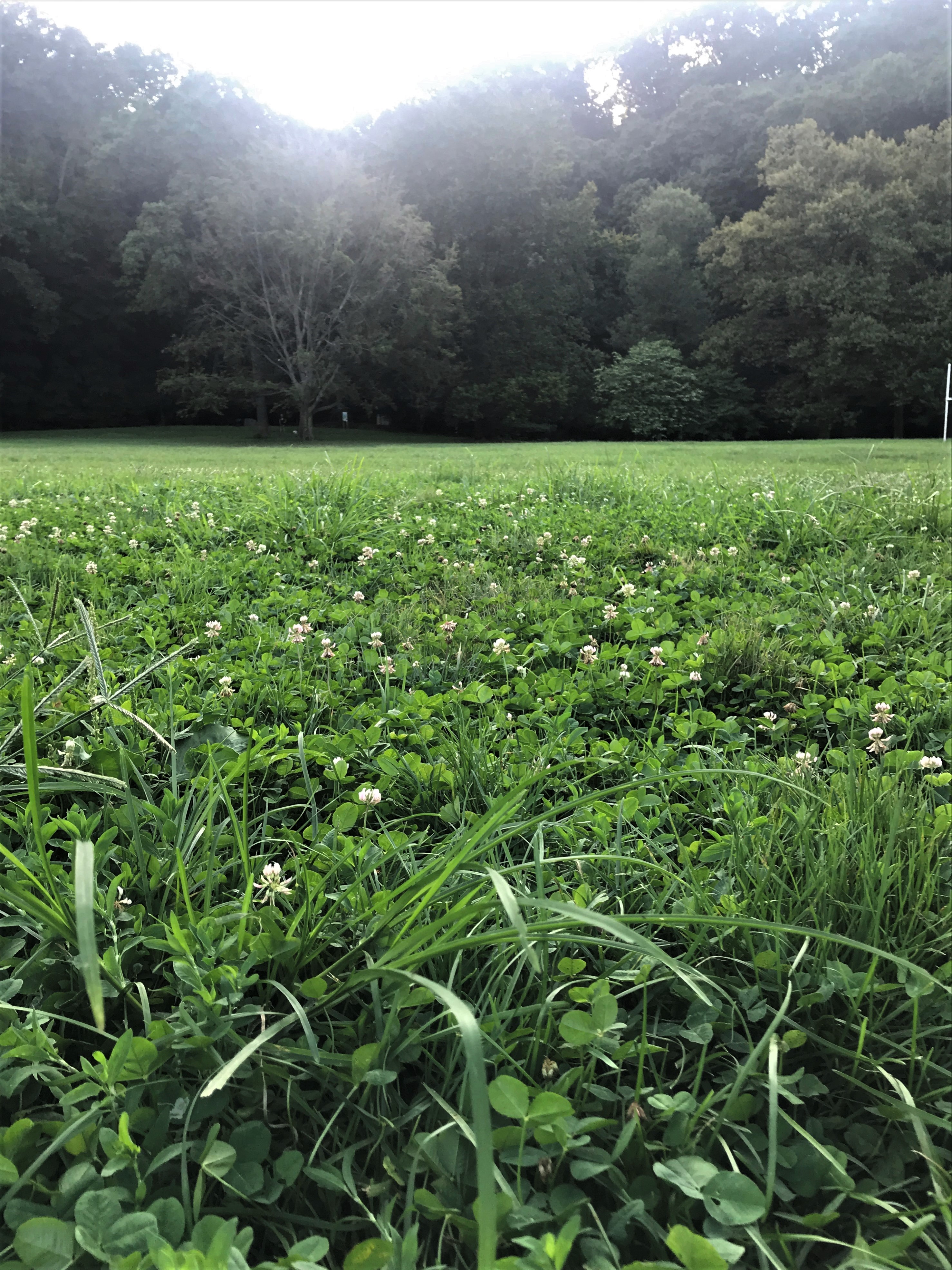
Inwood Hill Park 6-28 p.m. 8-20-2019

Inwood Hill Park, New York City; photograph by Roger W. Smith

A child said, What is the grass? fetching it to me with full
hands;
How could I answer the child?. . . .I do not know what it
is any more than he.

I guess it must be the flag of my disposition, out of hopeful
green stuff woven.

Or I guess it is the handkerchief of the Lord,
A scented gift and remembrancer designedly dropped,
Bearing the owner’s name someway in the corners, that we
may see and remark, and say Whose?

Or I guess the grass is itself a child. . . .the produced babe
of the vegetation.

Or I guess it is a uniform hieroglyphic,
And it means, Sprouting alike in broad zones and narrow
zones,
Growing among black folks as among white,
Kanuck, Tuckahoe, Congressman, Cuff, I give them the
same, I receive them the same.

And now it seems to me the beautiful uncut hair of graves.

Tenderly will I use you curling grass,
It may be you transpire from the breasts of young men,
It may be if I had known them I would have loved them;
It may be you are from old people and from women, and
from offspring taken soon out of their mother’s laps,
And here you are the mother’s laps.

This grass is very dark to be from the white heads of old
mothers,
Darker than the colorless beards of old men,
Dark to come from under the faint red roofs of mouths.

O I perceive after all so many uttering tongues!
And I perceive they do not come from the roofs of mouths
for nothing.

I wish I could translate the hints about the dead young men
and women,
And the hints about old men and mothers, and the offspring
taken soon out of their laps.

What do you think has become of the young and old men?
What do you think has become of the women and
children?

They are alive and well somewhere;
The smallest sprouts show there is really no death,
And if ever there was it led forward life, and does not wait
at the end to arrest it,
And ceased the moment life appeared.

All goes onward and outward. . . . and nothing collapses,
And to die is different from what any one supposed, and
luckier.

— Walt Whitman, Leaves of Grass


*****************************************************

I wish to thank Elisabeth van der Meer for sharing her photograph from her adopted country, Finland, with me, and for giving me permission to post it.


— Roger W. Smith

   July 6, 2018

immigration policy, Walt Whitman, and Donald Trump’s wall; or, the Berlin Wall redux


‘immigration policy, Walt Whitman, and Donald Trump’s wall’

Word document above


“Immigrants are some of the most courageous and industrious people humanity has to offer.”

— Chardo Richardson, House of Representatives candidate in Florida


“[W]hen New York was being abandoned in the 1960s and 1970s, a flood tide of immigrants reached the city. They helped to save it, to expand it by more than 1.5 million people, and to make it into one of the country’s most powerful economic engines. …

More than 3.2 million people born in other countries live in New York, and nearly half the labor force is immigrants. … Immigrants are no more an existential threat to New York than bicycle paths.”

— “Immigrants Are Not the Enemy, They Are Us,” by Jim Dwyer, The New York Times, November 2, 2017

Jim Dwyer, ‘Immigrants Are Not the Enemy’ – NY Times 11-2-2017


“ICE operates through the tactics of fear, violence and intimidation, with questionable legality, and tears families apart. “We applaud the growing number of progressives who are calling for an end to this terror.”

— Stephanie Taylor, founder of Progressive Change Campaign Committee


And once again the scene was changed,
New earth there seemed to be.
I saw the Holy City
Beside the tideless sea.
The light of God was on its streets,
The gates were open wide,
And all who would might enter,
And no one was denied.

— “The Holy City,” music by Stephen Adams; words by Frederick E. Weatherly


*****************************************************

For decades, open borders have allowed drugs and gangs to pour into our most vulnerable communities. They have allowed millions of low-wage workers to compete for jobs and wages against the poorest Americans. Most tragically, they have caused the loss of many innocent lives. …

Tonight, I am calling on the Congress to finally close the deadly loopholes that have allowed MS-13, and other criminals, to break into our country. We have proposed new legislation that will fix our immigration laws, and support our ICE and Border Patrol Agents, so that this cannot ever happen again.

The United States is a compassionate nation. We are proud that we do more than any other country to help the needy, the struggling, and the underprivileged all over the world. But as President of the United States, my highest loyalty, my greatest compassion, and my constant concern is for America’s children, America’s struggling workers, and America’s forgotten communities. … My duty, and the sacred duty of every elected official in this chamber, is to defend Americans — to protect their safety, their families, their communities, and their right to the American Dream. Because Americans are dreamers too. …

Here are the four pillars of our plan: … The second pillar fully secures the border. That means building a wall on the Southern border, and it means hiring more heroes … to keep our communities safe. Crucially, our plan closes the terrible loopholes exploited by criminals and terrorists to enter our country — and it finally ends the dangerous practice of “catch and release.”

— Donald Trump, State of the Union Address, January 30, 2018


*****************************************************

In response to:

“Supreme Court Tie Blocks Obama Immigration Plan”
The New York Times
June 23, 2016

I offer the following brief comments of my own as well as pertinent quotations from Walt Whitman and about him.

The controversy over immigration has been going on for a long time.

— Roger W. Smith


************************************************

In response to great waves of immigration that occurred between 1880 and 1920, the so-called Brahmins had become ever more insistent about a particular perspective on American culture, asserting that the real, pure, or true Americans were Anglo-Saxons. The great migrations coincided with the founding of such groups as the Society of Mayflower Descendants and the Sons and Daughters of the American Revolution. The migrations also coincided with the efforts of publishers who commissioned numerous professors (almost all from New England) to write literary histories for high school and college use with the hope of unifying the heterogeneous American people under the “aegis of New England” by fashioning a national history anchored in that region. Nina Baym has noted that “conservative New England leaders knew all too well that the nation was an artifice and that no single national character undergirded it. And they insisted passionately . . . [on] instilling in all citizens those traits that they thought necessary for the future: self-reliance, self-control, and acceptance of hierarchy.

[Walt] Whitman, less radical in the 1850s in the face of the slavery crisis than many Boston intellectuals, had become by the 1880s increasingly associated with the teeming masses, the immigrants, the downtrodden of all types. Meanwhile some of the same Boston intellectuals who had led the charge for the emancipation of blacks had come to be associated with propriety, exclusiveness, and backsliding on racial issues. [It seems my New England ancestors had such prejudices.]

— Kenneth M. Price, To Walt Whitman, America (The University of North Carolina Press, 2004)


************************************************

It is a shame that what I consider to be enlightened attitudes do not prevail today. We do not seem to have reached, or advanced beyond, the point reached by Whitman in the evolution of his views.

Whitman, who got his start as a journalist, editorialized against all immigration restriction, insisting that America must embrace immigrants of all backgrounds.

— Roger W. Smith, June 2016


************************************************

The following are excerpts from Whitman’s poems and from remarks of Whitman that were recorded by his “Boswell,” Horace Traubel:

the perpetual coming of immigrants … the free commerce … the fluid movement of the population

— Walt Whitman, Preface to Leaves of Grass


‘’See, in my poems immigrants continually coming and landing,

— Walt Whitman, “Starting From Paumanok”; Leaves of Grass


The man’s body is sacred, and the woman’s body is sacred,
No matter who it is, it is sacred;
Is it a slave? Is it one of the dull-faced immigrants
just landed on the wharf?
Each belongs here or anywhere just as much as the well-off–just as much as you,
Each has his or her place in the procession.

— Walt Whitman, “I Sing the Body Electric”; Leaves of Grass


[Thomas B.] Harned broached the subject of the restriction of immigration, and happening to say, “most people believe in it—it’s very unpopular now-a-days not to believe in it,” W[hitman]. exclaimed contemptuously: “All, did you say, Tom—or almost all? Well, here’s one who spits it all out, contract labor, pauper labor, or anything else, notwithstanding.” Harned said: “I did not say I believe in restriction—I said most people do.” W. went on vehemently: “Well for you, Tom, that you do not say it. I have no fears of America—not the slightest. America is for one thing only–and if not for that for what? America must welcome all—Chinese, Irish, German, pauper or not, criminal or not—all, all, without exceptions: become an asylum for all who choose to come. We may have drifted away from this principle temporarily but time will bring us back. The tide may rise and rise again and still again and again after that, but at last there is an ebb–the low water comes at last. Think of it—think of it: how little of the land of the United States is cultivated–how much of it is still utterly untilled. When you go West you sometimes travel whole days at lightning speed across vast spaces where not an acre is plowed, not a tree is touched, not a sign of a house is anywhere detected. America is not for special types, for the caste, but for the great mass of people–the vast, surging, hopeful, army of workers. Dare we deny them a home—close the doors in their face–take possession of all and fence it in and then sit down satisfied with our system—convinced that we have solved our problem? I for my part refuse to connect America with such a failure—such a tragedy, for tragedy it would be.” W. spoke with the greatest energy. It is a subject that always warms him up. “You see,” he said finally, “that the immigrant, too, like the writer, comes up against the canons, and has to last them out.”

— Horace Traubel, With Walt Whitman in Camden, vol. II, pg. 34 (entry for Tuesday, July 24, 1888)


[Whitman] said: “I believe in the higher patriotism—not, my country whether or no, God bless it and damn the rest!—no, not that—but my country, to be kept big, to grow bigger, to lead the procession, not in conquest, however, but in inspiration. If the procession, not in conquest, however, but in inspiration.

— Horace Traubel, With Walt Whitman in Camden, vol. II, pg. 94 (entry for Sunday, August 5, 1888)


************************************************

For what it’s worth, I am thoroughly in agreement with Whitman.

We Americans, all of us, are the descendants of immigrants. They have brought so much in terms of cultural richness, ingenuity, initiative, and plain hard work to this nation. THEY are who and what make this country great.

I am completely opposed to Donald Trump’s Know Nothing stance. He wants to set us back a century in terms of attitudes towards immigrants. He wants to build a wall at the Mexican border! It’s the Berlin Wall redux.

Note — it’s ironic, is it not? — what Walt Whitman said emphatically (as quoted above) 128 years ago, when similar sentiments were being propagated: “Dare we … close the doors in their [immigrants’] face –take possession of all and fence it in [italics added]?”

In Berlin on June 12, 1987, President Ronald Reagan made the famous speech in which he said: “Mr. Gorbachev, open this gate. Mr. Gorbachev, tear down this wall!” The demolition of the wall began three years later.

Now Trump wants to build one of his own.


— posted by Roger W. Smith

  June 2016; updated July 2025


************************************************

Addendum:


I recently came across a brief but very persuasive — and I feel important — article in The Wall Street Journal:

“Immigration Is Practically a Free Lunch for America; Tax cuts are well and good, but the surest way to spur economic growth is to let in more people,” By Neel Kashkari, The Wall Street Journal, January 19, 2018

https://www.wsj.com/articles/immigration-is-practically-a-free-lunch-for-america-1516661314

As Congress and the Trump administration debate immigration reforms with important legal and social implications, they must not lose sight of an overarching truth: Robust immigration levels are vital to growing the American economy.

Legislators of both parties, policy makers and families all want faster economic growth because it produces more resources to fund national priorities and raise living standards. But growth since the end of the Great Recession has been frustratingly slow, averaging only 2.2% net of inflation, down from 3.6% on average from 1960 to 2000.

Republicans hope the new tax cuts will lead the economy to grow faster. But while stimulus plans can indeed produce growth at least temporarily, they usually do so by increasing the deficit. Can’t policy makers achieve faster growth without further ballooning our national debt? Yes–and increasing immigration levels is the most reliable way to do so.

Long-term economic growth comes from two sources: productivity growth and population growth. Productivity growth means the same number of workers are able to produce more goods and services. Increased productivity comes from better education (equipping workers with better skills) and technology development (giving workers more sophisticated tools). Productivity growth has been very low during this recovery, averaging only 1.1% per year, down from 2.1% from 1960 to 2000.

We can’t predict whether productivity growth is going to return to prior levels on its own. Congress could decide to spend more on education or basic research to boost productivity, but it takes years for such investments to translate into a more productive economy. That doesn’t mean they aren’t worth making, but the payoffs are highly uncertain.

Population growth drives economic growth because a larger population means more workers to produce things and more consumers to buy things. But as is true in most other advanced economies, Americans are having fewer children. The U.S. working-age population has stagnated over the past decade.

Using public policy to increase the nation’s fertility rate is not easy. Congress could try to create economic incentives for families to have more children by offering tax credits and free child care, but both would be expensive and take years to move the needle on population growth. The surest way to increase the working-age population is through immigration.

The article demonstrates conclusively — in a few words — what I have always felt intuitively: that immigration is not only good policy from a social/cultural, sociological, and humanitarian point of view — or what have you — but that it also makes sense economically. It is desirable both morally, so to speak and practically. I can feel this in my own bustling city.

— Roger W. Smith

  June 2018


************************************************

See also:

“President Trump, How Is This Man a Danger?”
Op-Ed
By Nicholas Kristof
The New York Times
February 10, 2018
Nicholas Kristof, ‘President Trump, How Is This Man a Danger’

“Up Against the Wall” (editorial)
The New York Times
April 8, 2017
‘Up Against the Wall’ – NY Times 4-8-2017

A very penetrating analysis of what’s wrong with Trump’s proposal to build a wall at our Southern border.

“Queens man, a father of two, facing deportation to China after arrest at immigration interview”
By Erin Durkin
New York Daily News
June 15, 2018

Queens man, a father of two, facing deportation to China after arrest at immigration interview


Plus:


“Supreme Court’s ruling on immigration reform raises fear of deportation for 4 million people, including families living in U.S. for decades”
By Chelsia Rose Marcius and Stephen Rex Brown
Daily News (New York)
April 8, 2018
http://www.nydailynews.com/news/national/scotus-immigration-ruling-puts-millions-deportation-limbo-article-1.2685908

For Obama, Supreme Court Defeat Upends a Legacy on Immigration
By Michael D. Shear and Trip Gabriel
The New York Times
June 23, 2016
‘Supreme Court tie blocks Obama immigration plan’ – NY Times

How the Supreme Court’s deadlock will change immigration politics
The Washington Post
June 24, 2016
https://www.washingtonpost.com/news/monkey-cage/wp/2016/06/24/how-the-supreme-courts-deadlock-will-change-immigration-politics/


*****************************************************

See also:

“We Will Regret Not Standing Up to This Venomous Cruelty”

By Linda Greenhouse

The New York Times

July 14, 2025

‘We Will Regret Not Standing Up to This Venomous Cruelty’ – NY Times 7-14-2025