Category Archives: miscellaneous

“Abstract yourself from this book …”


Walt Whitman, ‘Abstract yourself from this book’ (prose fragment)

PDF above.

Abstract yourself from this book; realize where you are at present located, the point you stand that is now to you the centre of all. Look up overhead, think of space stretching out, think of all the unnumbered orbs wheeling safely there, invisible to us by day, some visible by night … . Spend some minutes faithfully in this exercise. Then again realize yourself upon the earth, at the particular point you now occupy … [thinks of four directions]. Seize these firmly in your mind, pass freely over immense distances. Turn your face a moment thither. Fix definitely the direction and the idea of the distances of separate sections of your own country, also of England, the Mediterranean sea, Cape Horn, the North Pole, and such like distant places.

— Walt Whitman, “? Outset of Lecture,” IN Notebooks and Unpublished Prose Manuscripts, Volume IV, edited by Edward F. Grier ( New York University Press , 1984)

This quote from Whitman’s notes to himself is, in my opinion, highly significant – in that it reveals the type of thinking and perspective that went into the writing of his great poems, notably the early ones.

— posted by Roger W. Smith

   March 2023

Introduction, “The Half-Breed and Other Stories by Walt Whitman”


Introduction, ‘The Half-Breed and Other Stories’


I have obtained a rare book:

The Half-Breed and Other Stories by Walt Whitman

Collected and Edited by Thomas Ollive Mabbott

Columbia University Press, 1927

I have posted here the Introduction by the editor, Thomas Ollive Mabbott. The pages were difficult to copy due to the book’s tight binding.

The early stories by Whitman in this hook have been reprinted in Walt Whitman, The Early Poems and the Fiction, edited by Thomas L. Brasher (New York University Press, 1963).


— posted by Roger W. Smith

   March 2023

“When Boston Censored Walt Whitman” (NY Times)


‘When Boston Censored Walt Whitman’ – NY Times Magazine 6-19-1927


Posted here (PDF file above):

“When Boston Censored Walt Whitman”

By Frederick P. Hebb Jr.

New York Times Magazine

June 19, 1927


– posted by Roger W. Smith

   October 2022

Robert G. Ingersoll, “Address at the Funeral of Walt Whitman”


Robert G. Ingersoll, ‘Address at the Funeral of Walt Whitman’


Posted here (downloadable PDF document above) is Robert G. Ingersoll’s eulogy for Walt Whitman, which was delivered on March 30, 1892 at Harleigh Cemetery in Camden, New Jersey.


*****************************************************

Robert G. Ingersoll (1833-1899) was an American lawyer, writer, and orator. Known as “The Great Agnostic,” Ingersoll was a staunch advocate of free thought.

Ingersoll was a close friend of Walt Whitman. They had profound admiration for one another, as can be seen by anyone who reads Horace Traubel’s multivolume work With Walt Whitman in Camden. “It should not be surprising that I am drawn to Ingersoll, for he is ‘Leaves of Grass’ … He lives, embodies, the individuality, I preach. I see in Bob [Ingersoll] the noblest specimen–American-flavored–pure out of the soil, spreading, giving, demanding light,” Whitman told Traubel.


— posted by Roger W. Smith

   March 2021

a disservice to Walt Whitman


Walt Whitman – NY Times 9-14-2020

Whitman to John Addington Symonds


re:

“Walt Whitman, Poet of a Contradictory America: During the Civil War era, the writer emerged as an emblem of the country’s dissonance. Now, in the midst of another all-consuming national crisis, his work feels uncannily relevant.”

By Jesse Green

The New York Times

September. 14, 2020

‘Walt Whitman; Poet of a Contradictory America’ – NY Tiimes Magazine 9-14-2020


*****************************************************

This article includes “pictures, the essay’s writer and T’s editors chose some of their favorite passages of Walt Whitman’s poetry — excerpted below as he published them in the 1891-92 edition of “Leaves of Grass” — which the photographer, stylist and models referenced to inspire the images, taken on July 24, 2020, at St. Josaphat’s Monastery in Glen Cove, N.Y.”

Take a look for yourself to see how tawdry and pitiful this is.


*****************************************************

The following are excerpts from the article, by Jesse Green, the Times’s co-chief theater critic. With thoughts/comments by me in ALL CAPS.

The 13-part newspaper series on manly health he wrote a few years earlier, in 1858, under the pseudonym Mose Velsor, is full of epigrammatic dictums — “the beard is a great sanitary protection to the throat” and “we have spoken against the use of the potato” — but for long passages comes off as unintentional gay porn.

Of course, so do long passages of his signed work.

GAY PORN? COME ON! I HAVE READ THE ENTIRE 1858 NEWSPAPER SERIES BY WHITMAN REFERRED TO. (IT WAS RECENTLY PUBLISHED IN BOOK FORM AS Manly Health and Training.) GREEN DELIBERATELY MISCHARACTERIZES THIS WORK OR ITS INTENTION.


Six years before the war, in June 1855, Whitman published the first edition of “Leaves of Grass,” a book of poems he would prune and shape, like a massive topiary, until his death in 1892 at the age of 72. That he believed it to be not just his masterpiece but America’s, and that America somehow came to agree, seems so wildly unlikely when you actually read it that the reading throws you into a time warp. Are we in classical Greece, as the antique cadences and references sometimes suggest? Adamic Eden? The Summer of Love in San Francisco’s Haight-Ashbury? Pre-Columbian America? Or tonight on Grindr? (Polar Bear, highly verbal, Masc4Masc.) Not many other masterpieces of the 19th century fill their pages with kisses among “camerados,” testicular gropes (“the sensitive, orbic, underlapp’d brothers”), hydrothermal ejaculations (“the pent-up rivers of myself”) and the scent of armpits “finer than prayer.” Even in the unlikely event that Whitman merely imagined such things, they have the authenticity of aspiration. You can see it in the portrait he chose for the frontispiece of the first edition: an engraving of the author with his hips, hat and eyebrows all cocked, with his lanky frame in a louche slouch that any gay man in Brooklyn Heights today (I live a quarter-mile from the printing house where it was typeset) would take as a welcome, a come-on, a song of himself.

TOTALLY UNJUSTIFIED INSINUATIONS/INFERENCES, “CRITICAL OBSERVATIONS” ABOUT LEAVES OF GRASS. THE REFERENCE TO ‘ANTIQUE CADENCES” SHOWS IGNORANCE. WHITMAN WANTED, CHOSE DELIBERATELY, TO AVOID ALL ECHOES OF CLASSICAL LITERATURE.


It is only as an icon of queerness that Whitman’s legacy is sometimes denied, as if gay people, rooting through the crypts of time, had dug up the wrong body. For decades, heterosexual critics commonly treated the homoerotic passages as metaphor or, like Harold Bloom, asserted that all those loving comrades were actually just platonic friends. (Bloom called Whitman’s sexuality “onanistic.”) And though it’s true (as Justin Kaplan tells us in “Walt Whitman: A Life,” his 1980 biography) that in old age the poet casually, even cruelly, dismissed an anguished acolyte’s plea to acknowledge the actual sex shadowing the metaphysical sex in his work — “morbid inferences,” he answered in an 1890 letter, “disavow’d” and “damnable” — that hasn’t stopped gay men since liberation from celebrating the truth for what it is and making Walt their poster boy. After all, how metaphysical can an erection be? (In the preface to the 1856 edition of “Leaves of Grass,” Whitman pledges to restore the “desires, lusty animations, organs, acts” that had been “driven to skulk out of literature with whatever belongs to them.”) Whether or not he sired six children, as he sometimes claimed, though none are known to have come knocking in search of a handout or benediction, they would not be dispositive anyway: Most homophile men have until recently also had wives and children — and Whitman called at least one of his likely young lovers “dear son.”

RE WHITMAN AS AN ICON OF QUEERNESS, SEE MY COMMENTS BELOW.

RE “In old age the poet casually, even cruelly, dismissed an anguished acolyte’s plea,” [ITALICS ADDED], THE LETTER OF WHITMAN TO AN ENGLISH ACOLYTE (JOHN ADDINGTON SYMONDS) IS PRESERVED IN DRAFT FORM — I.E., A DRAFT BY WHITMAN. SYMONDS’S LETTER (I.E., FROM WHITMAN TO HIM) HAS NOT BEEN PRESERVED APPARENTLY. (IT HAS NOT BEEN PUBLISHED.) I HAVE POSTED HERE (ABOVE) AS A WORD DOCUMENT MY TRANSCRIPTION OF WHITMAN’S DRAFT. TO CALL THE LETTER OR ITS TONE CRUEL AND TO SAY THAT IT AMOUNTED TO CASUAL DISMISSAL IS OVERREACH — TO SAY NOTHING OF BEING INACCURATE.

GREEN DID NOT STUDY WHITMAN’S DRAFT LETTER CLOSELY. HE LEARNED ABOUT IT FROM JUSTIN KAPLAN’S BIOGRAPHY OF WHITMAN. KAPLAN STATES THAT WHITMAN’S LETTER (DRAFT OF SAME) TO SYMONDS WAS “CALCULATINGLY CASUAL,” WHICH IS NOT THE SAME AS CASUAL. IN FACT, WHILE WHITMAN DID TRY TO KEEP THE TONE MEASURED, IT IS OBVIOUS HOW CAREFULLY HE DRAFTED THE REPLY. WHITMAN, IN WRITING TO SYMONDS, CLEARLY WAS ON THE SPOT, FELT DEFENSIVE. HE WRITES WITH RESERVE AND ISSUES A FIRM DENIAL. NOTHING LESS AND NOTHING MORE.


What he isn’t, at least at the time he went on his milk diet, nor during the years when he produced the first editions of “Leaves of Grass,” is amatively mature. “The best I had done seem’d to me blank and suspicious,” he admits in the same poem. “Many I loved in the street or ferry-boat or public assembly, yet never told them a word.” Despite their enthusiastic (and unquestionably transporting) wide-world embraces, these early writings often suggest high school aesthetes pining in diaries for high school athletes. They want more from others than they dare say directly.

THIS IS PSYCHOBABBLE TRIVIALIZING THE WORK OF A GREAT POET (AMERICA’S GREATEST), AS IF HE WERE THE WRITER OF LYRICS TO POP SONGS OR PERHAPS GRAPHIC NOVELS.


… his need for the “comradeship and sometimes affection” of stevedores, farmhands and omnibus drivers begins to make sense when you recognize that unresolved split in him. Here was a nascent voice of the common man but also a mama’s boy, theater buff and opera freak who shared elderberry wine with Oscar Wilde. Wobbling like an adolescent between wanting to possess the other and be him, Whitman — and, because he represented America, America — did not yet know what destiny held or how to find it. In that way, his diet was spiritual: a means of annealing his body for the great work ahead.

MORE JEJUNE PSYCHOBABBLE.


Whitman embodied cognitive dissonance. His freethinking coexisted with a lifelong project of self-editing, literal and otherwise, in service not just to his art but his ambition. “Leaves of Grass” was no less ruthlessly pruned and reshaped over the decades than his own public persona; he could not have become The Good Gray Poet without sanding down his pervy edges in deference to prejudices he may or may not have outgrown himself. It remains impossible to say whether his denial of gay affairs, like his denial of full personhood for Black and Indigenous people, was unexamined prejudice or savvy self-promotion.

“COGNITIVE DISSONANCE” … “PERVY EDGES”: MORE PSYCHOBABBLE AND DEMEANING WITH CANT.


How different he sounds from his contemporaries, even American ones, except for Emily Dickinson, whose similarly pioneering and proto-queer work would not become widely known until after her death in 1886.

NOTE THE SNARKY, CONFIDENT ASSERTION THAT EMILY DICKENSON’S POETRY WAS “PROTO-QUEER.” THIS IS MORE CUTE GLIBNESS. SERIOUS LITERARY SCHOLARS HAVE RECENTLY WRITTEN ESSAYS INVESTIGATING WHETHER EMILY DICKINSON HAD LONGINGS FOR WOMEN AND RELATIONSHIPS WITH THEM. IT MAY BE TRUE. IS IT PROVEN?


*****************************************************

My former therapist, Dr. Ralph Colp Jr. – a highly literate and well-read person and a scholar in his own right, how many MDs and psychiatrists or therapists can this be said of? – made two significant observations to me about Whitman. First, that gays were very eager to claim him as one of them, and that this reflected something gays tend to do. Second, that he (Dr. Colp) felt that Whitman handled questions about his sexual orientation very well – meaning discretion, not disclosing more than he wished to – as Whitman’s way of dealing with such inquiries.

A comment (responding to the Times article) that was posted on the Times site yesterday reads as follows:

Samuel, Denver

Sept. 15

It’s not that anything this article says is wrong. It’s just that because of the lens the writer writes through (proud gay) and the contextual pictures (over-expensive clothing), there is nothing quite right here either. Whitman celebrated sexuality — all sexual desires and behaviors — and he celebrated freedom, including the freedom to NOT be defined by any particular bent of those sexual desires. This is the exact opposite of modern gay movements, which insist on the definition of the self by one’s sexual preference. This is why Whitman denounced “an anguished acolyte’s [John Addington Symonds, not named by Green] plea” – because the acolyte got it wrong and wanted to pigeon-hole a man whose manifesto was freedom.

Whitman’s poetry isn’t gay. It’s pan-sexual, free to ever cross borders and return back — completely free of being defined by the preference of the moment. This sort of freedom is almost entirely unknown today in a world where people want to loudly define themselves by all sorts of preferences, and do not seek or admire the freedom that comes with refusing to be defined by one definition and embracing a multitude of possibilities. That is what Whitman continually did: he included everything in his self-definition; he “contained multitudes.”

As for the pictures with the article . . . really? How tone-deaf can you be?

I completely agree with Samuel. I don’t care whatsoever whether Whitman was gay or not. I think he probably was gay. But there is no conclusive proof. And, anyway, as I just said, I don’t care.


— posted by Roger W. Smith

   September 16, 2020

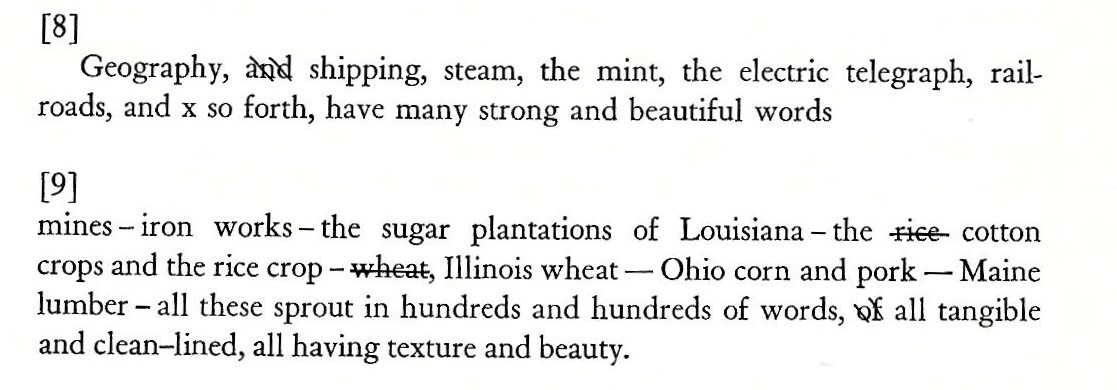
Walt Whitman creates a catalogue


Walt Whitman: Daybooks and Notebooks, edited by William White, Volume III, pg. 733 (New York University Press, 1978)


Interlink’ d, food-yielding lands!
Land of coal and iron! land of gold! land of cotton, sugar, rice! Land of wheat, beef, pork! land of wool and hemp! land of the
apple and the grape!
Land of the pastoral plains, the grass-fields of the world! land of
those sweet-air’d interminable plateaus!
Land of the herd, the garden, the healthy house of adobie! Lands where the north-west Columbia winds, and where the
south-west Colorado winds!
Land of the eastern Chesapeake! land of the Delaware!
Land of Ontario, Erie, Huron, Michigan!
Land of the Old Thirteen! Massachusetts land! land of Vermont
and Connecticut!
Land of the ocean shores! land of sierras and peaks!

— from Walt Whitman, “Starting from Paumanok”


excerpt from ‘Starting from Paumanok’


*****************************************************

Walt Whitman’s catalogues. Long lists. A stylistic feature of his poetry.


posted by Roger W. Smith

  August 2020

how could she omit the dates? (Whitman scholars won’t be happy)


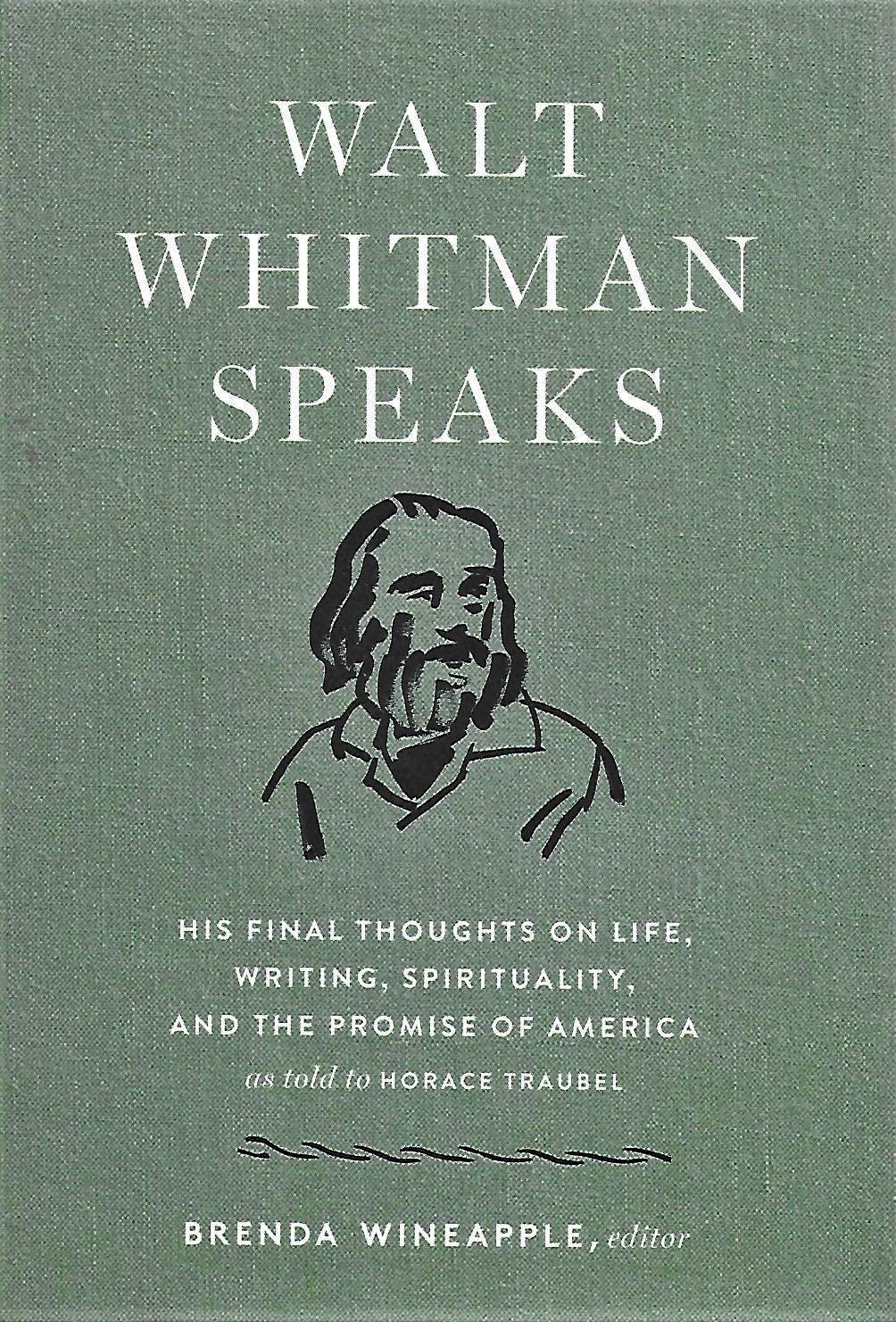
'Walt Whitman Speaks' -book cover


I purchased yesterday at the Stand Bookstore the following slim book:

Walt Whitman Speaks: His Final Thoughts on Life, Writing, Spirituality, and the Promise of America

as told to Horace Traubel

edited and with an introduction by Brenda Wineapple

New York: Library of America, 2019

Whitman’s remarks are grouped, arranged, by topic.

They are all taken from With Walt Whitman in Camden by Whitman’s friend and acolyte Horace Traubel. Nowhere in the present volume is there any indication of on what DATE the conversation with Traubel occurred (all of which is fully indicted in the nine volumes of Traubel’s).

In James Boswell’s Life of Johnson, the date on which a conversation with Johnson occurred is an important consideration, and was duly noted by Boswell. Same thing here (regarding the importance of dating when the remark was made).

What was Brenda Wineapple thinking? She is an accomplished and well known American literary scholar. I blame her, and also the Library of America.

Whitman scholars will be disappointed.


— Roger W. Smith

    May 2019

an early take by Walt Whitman on his conception of himself as America’s poet


Walt Whitman began his writing career as a journalist. He was known early on for writing anonymous reviews of Leaves of Grass — in other words, reviewing himself, in laudatory terms. A motivation for his doing this was that he clearly felt his poetic endeavor would not be understood by the literati or his countrymen, and indeed his poetry initially baffled most and offended many because of its frankness, or what one might call lack of reticence when it came to topics not discussed in polite society. Even his own family seems not to have for the most part read his poetry or understood it.

Below is an unpublished puff piece by Whitman that was in his papers. It is not un-similar to anonymous reviews of Leaves of Grass he actually wrote. His conception of himself as a sort of literary gatecrasher is amusing. It has more than a grain of truth.


— Roger W. Smith

   August 2018


*****************************************************

We suppose it will excite the mirth of many of our readers to be told that a man has arisen, who has deliberately and insultingly ignored all the other, the cultivated classes as they are called, and set himself to write “America’s first distinctive Poem,” on the platform of these same New York Roughs, firemen, the ouvrier class, masons and carpenters, stagedrivers, the Dry Dock boys, and so forth; and that furthermore, he either is not aware of the existence of the polite social models, and the imported literary laws, or else he don’t value them two cents for his purposes.

Notes and Fragments, edited by R. M. Bucke; in Complete Writings of Walt Whitman, vol. IX (New York, 1902), pg. 70

immigration policy, Walt Whitman, and Donald Trump’s wall; or, the Berlin Wall redux


‘immigration policy, Walt Whitman, and Donald Trump’s wall’

Word document above


“Immigrants are some of the most courageous and industrious people humanity has to offer.”

— Chardo Richardson, House of Representatives candidate in Florida


“[W]hen New York was being abandoned in the 1960s and 1970s, a flood tide of immigrants reached the city. They helped to save it, to expand it by more than 1.5 million people, and to make it into one of the country’s most powerful economic engines. …

More than 3.2 million people born in other countries live in New York, and nearly half the labor force is immigrants. … Immigrants are no more an existential threat to New York than bicycle paths.”

— “Immigrants Are Not the Enemy, They Are Us,” by Jim Dwyer, The New York Times, November 2, 2017

Jim Dwyer, ‘Immigrants Are Not the Enemy’ – NY Times 11-2-2017


“ICE operates through the tactics of fear, violence and intimidation, with questionable legality, and tears families apart. “We applaud the growing number of progressives who are calling for an end to this terror.”

— Stephanie Taylor, founder of Progressive Change Campaign Committee


And once again the scene was changed,
New earth there seemed to be.
I saw the Holy City
Beside the tideless sea.
The light of God was on its streets,
The gates were open wide,
And all who would might enter,
And no one was denied.

— “The Holy City,” music by Stephen Adams; words by Frederick E. Weatherly


*****************************************************

For decades, open borders have allowed drugs and gangs to pour into our most vulnerable communities. They have allowed millions of low-wage workers to compete for jobs and wages against the poorest Americans. Most tragically, they have caused the loss of many innocent lives. …

Tonight, I am calling on the Congress to finally close the deadly loopholes that have allowed MS-13, and other criminals, to break into our country. We have proposed new legislation that will fix our immigration laws, and support our ICE and Border Patrol Agents, so that this cannot ever happen again.

The United States is a compassionate nation. We are proud that we do more than any other country to help the needy, the struggling, and the underprivileged all over the world. But as President of the United States, my highest loyalty, my greatest compassion, and my constant concern is for America’s children, America’s struggling workers, and America’s forgotten communities. … My duty, and the sacred duty of every elected official in this chamber, is to defend Americans — to protect their safety, their families, their communities, and their right to the American Dream. Because Americans are dreamers too. …

Here are the four pillars of our plan: … The second pillar fully secures the border. That means building a wall on the Southern border, and it means hiring more heroes … to keep our communities safe. Crucially, our plan closes the terrible loopholes exploited by criminals and terrorists to enter our country — and it finally ends the dangerous practice of “catch and release.”

— Donald Trump, State of the Union Address, January 30, 2018


*****************************************************

In response to:

“Supreme Court Tie Blocks Obama Immigration Plan”
The New York Times
June 23, 2016

I offer the following brief comments of my own as well as pertinent quotations from Walt Whitman and about him.

The controversy over immigration has been going on for a long time.

— Roger W. Smith


************************************************

In response to great waves of immigration that occurred between 1880 and 1920, the so-called Brahmins had become ever more insistent about a particular perspective on American culture, asserting that the real, pure, or true Americans were Anglo-Saxons. The great migrations coincided with the founding of such groups as the Society of Mayflower Descendants and the Sons and Daughters of the American Revolution. The migrations also coincided with the efforts of publishers who commissioned numerous professors (almost all from New England) to write literary histories for high school and college use with the hope of unifying the heterogeneous American people under the “aegis of New England” by fashioning a national history anchored in that region. Nina Baym has noted that “conservative New England leaders knew all too well that the nation was an artifice and that no single national character undergirded it. And they insisted passionately . . . [on] instilling in all citizens those traits that they thought necessary for the future: self-reliance, self-control, and acceptance of hierarchy.

[Walt] Whitman, less radical in the 1850s in the face of the slavery crisis than many Boston intellectuals, had become by the 1880s increasingly associated with the teeming masses, the immigrants, the downtrodden of all types. Meanwhile some of the same Boston intellectuals who had led the charge for the emancipation of blacks had come to be associated with propriety, exclusiveness, and backsliding on racial issues. [It seems my New England ancestors had such prejudices.]

— Kenneth M. Price, To Walt Whitman, America (The University of North Carolina Press, 2004)


************************************************

It is a shame that what I consider to be enlightened attitudes do not prevail today. We do not seem to have reached, or advanced beyond, the point reached by Whitman in the evolution of his views.

Whitman, who got his start as a journalist, editorialized against all immigration restriction, insisting that America must embrace immigrants of all backgrounds.

— Roger W. Smith, June 2016


************************************************

The following are excerpts from Whitman’s poems and from remarks of Whitman that were recorded by his “Boswell,” Horace Traubel:

the perpetual coming of immigrants … the free commerce … the fluid movement of the population

— Walt Whitman, Preface to Leaves of Grass


‘’See, in my poems immigrants continually coming and landing,

— Walt Whitman, “Starting From Paumanok”; Leaves of Grass


The man’s body is sacred, and the woman’s body is sacred,
No matter who it is, it is sacred;
Is it a slave? Is it one of the dull-faced immigrants
just landed on the wharf?
Each belongs here or anywhere just as much as the well-off–just as much as you,
Each has his or her place in the procession.

— Walt Whitman, “I Sing the Body Electric”; Leaves of Grass


[Thomas B.] Harned broached the subject of the restriction of immigration, and happening to say, “most people believe in it—it’s very unpopular now-a-days not to believe in it,” W[hitman]. exclaimed contemptuously: “All, did you say, Tom—or almost all? Well, here’s one who spits it all out, contract labor, pauper labor, or anything else, notwithstanding.” Harned said: “I did not say I believe in restriction—I said most people do.” W. went on vehemently: “Well for you, Tom, that you do not say it. I have no fears of America—not the slightest. America is for one thing only–and if not for that for what? America must welcome all—Chinese, Irish, German, pauper or not, criminal or not—all, all, without exceptions: become an asylum for all who choose to come. We may have drifted away from this principle temporarily but time will bring us back. The tide may rise and rise again and still again and again after that, but at last there is an ebb–the low water comes at last. Think of it—think of it: how little of the land of the United States is cultivated–how much of it is still utterly untilled. When you go West you sometimes travel whole days at lightning speed across vast spaces where not an acre is plowed, not a tree is touched, not a sign of a house is anywhere detected. America is not for special types, for the caste, but for the great mass of people–the vast, surging, hopeful, army of workers. Dare we deny them a home—close the doors in their face–take possession of all and fence it in and then sit down satisfied with our system—convinced that we have solved our problem? I for my part refuse to connect America with such a failure—such a tragedy, for tragedy it would be.” W. spoke with the greatest energy. It is a subject that always warms him up. “You see,” he said finally, “that the immigrant, too, like the writer, comes up against the canons, and has to last them out.”

— Horace Traubel, With Walt Whitman in Camden, vol. II, pg. 34 (entry for Tuesday, July 24, 1888)


[Whitman] said: “I believe in the higher patriotism—not, my country whether or no, God bless it and damn the rest!—no, not that—but my country, to be kept big, to grow bigger, to lead the procession, not in conquest, however, but in inspiration. If the procession, not in conquest, however, but in inspiration.

— Horace Traubel, With Walt Whitman in Camden, vol. II, pg. 94 (entry for Sunday, August 5, 1888)


************************************************

For what it’s worth, I am thoroughly in agreement with Whitman.

We Americans, all of us, are the descendants of immigrants. They have brought so much in terms of cultural richness, ingenuity, initiative, and plain hard work to this nation. THEY are who and what make this country great.

I am completely opposed to Donald Trump’s Know Nothing stance. He wants to set us back a century in terms of attitudes towards immigrants. He wants to build a wall at the Mexican border! It’s the Berlin Wall redux.

Note — it’s ironic, is it not? — what Walt Whitman said emphatically (as quoted above) 128 years ago, when similar sentiments were being propagated: “Dare we … close the doors in their [immigrants’] face –take possession of all and fence it in [italics added]?”

In Berlin on June 12, 1987, President Ronald Reagan made the famous speech in which he said: “Mr. Gorbachev, open this gate. Mr. Gorbachev, tear down this wall!” The demolition of the wall began three years later.

Now Trump wants to build one of his own.


— posted by Roger W. Smith

  June 2016; updated July 2025


************************************************

Addendum:


I recently came across a brief but very persuasive — and I feel important — article in The Wall Street Journal:

“Immigration Is Practically a Free Lunch for America; Tax cuts are well and good, but the surest way to spur economic growth is to let in more people,” By Neel Kashkari, The Wall Street Journal, January 19, 2018

https://www.wsj.com/articles/immigration-is-practically-a-free-lunch-for-america-1516661314

As Congress and the Trump administration debate immigration reforms with important legal and social implications, they must not lose sight of an overarching truth: Robust immigration levels are vital to growing the American economy.

Legislators of both parties, policy makers and families all want faster economic growth because it produces more resources to fund national priorities and raise living standards. But growth since the end of the Great Recession has been frustratingly slow, averaging only 2.2% net of inflation, down from 3.6% on average from 1960 to 2000.

Republicans hope the new tax cuts will lead the economy to grow faster. But while stimulus plans can indeed produce growth at least temporarily, they usually do so by increasing the deficit. Can’t policy makers achieve faster growth without further ballooning our national debt? Yes–and increasing immigration levels is the most reliable way to do so.

Long-term economic growth comes from two sources: productivity growth and population growth. Productivity growth means the same number of workers are able to produce more goods and services. Increased productivity comes from better education (equipping workers with better skills) and technology development (giving workers more sophisticated tools). Productivity growth has been very low during this recovery, averaging only 1.1% per year, down from 2.1% from 1960 to 2000.

We can’t predict whether productivity growth is going to return to prior levels on its own. Congress could decide to spend more on education or basic research to boost productivity, but it takes years for such investments to translate into a more productive economy. That doesn’t mean they aren’t worth making, but the payoffs are highly uncertain.

Population growth drives economic growth because a larger population means more workers to produce things and more consumers to buy things. But as is true in most other advanced economies, Americans are having fewer children. The U.S. working-age population has stagnated over the past decade.

Using public policy to increase the nation’s fertility rate is not easy. Congress could try to create economic incentives for families to have more children by offering tax credits and free child care, but both would be expensive and take years to move the needle on population growth. The surest way to increase the working-age population is through immigration.

The article demonstrates conclusively — in a few words — what I have always felt intuitively: that immigration is not only good policy from a social/cultural, sociological, and humanitarian point of view — or what have you — but that it also makes sense economically. It is desirable both morally, so to speak and practically. I can feel this in my own bustling city.

— Roger W. Smith

  June 2018


************************************************

See also:

“President Trump, How Is This Man a Danger?”
Op-Ed
By Nicholas Kristof
The New York Times
February 10, 2018
Nicholas Kristof, ‘President Trump, How Is This Man a Danger’

“Up Against the Wall” (editorial)
The New York Times
April 8, 2017
‘Up Against the Wall’ – NY Times 4-8-2017

A very penetrating analysis of what’s wrong with Trump’s proposal to build a wall at our Southern border.

“Queens man, a father of two, facing deportation to China after arrest at immigration interview”
By Erin Durkin
New York Daily News
June 15, 2018

Queens man, a father of two, facing deportation to China after arrest at immigration interview


Plus:


“Supreme Court’s ruling on immigration reform raises fear of deportation for 4 million people, including families living in U.S. for decades”
By Chelsia Rose Marcius and Stephen Rex Brown
Daily News (New York)
April 8, 2018
http://www.nydailynews.com/news/national/scotus-immigration-ruling-puts-millions-deportation-limbo-article-1.2685908

For Obama, Supreme Court Defeat Upends a Legacy on Immigration
By Michael D. Shear and Trip Gabriel
The New York Times
June 23, 2016
‘Supreme Court tie blocks Obama immigration plan’ – NY Times

How the Supreme Court’s deadlock will change immigration politics
The Washington Post
June 24, 2016
https://www.washingtonpost.com/news/monkey-cage/wp/2016/06/24/how-the-supreme-courts-deadlock-will-change-immigration-politics/


*****************************************************

See also:

“We Will Regret Not Standing Up to This Venomous Cruelty”

By Linda Greenhouse

The New York Times

July 14, 2025

‘We Will Regret Not Standing Up to This Venomous Cruelty’ – NY Times 7-14-2025